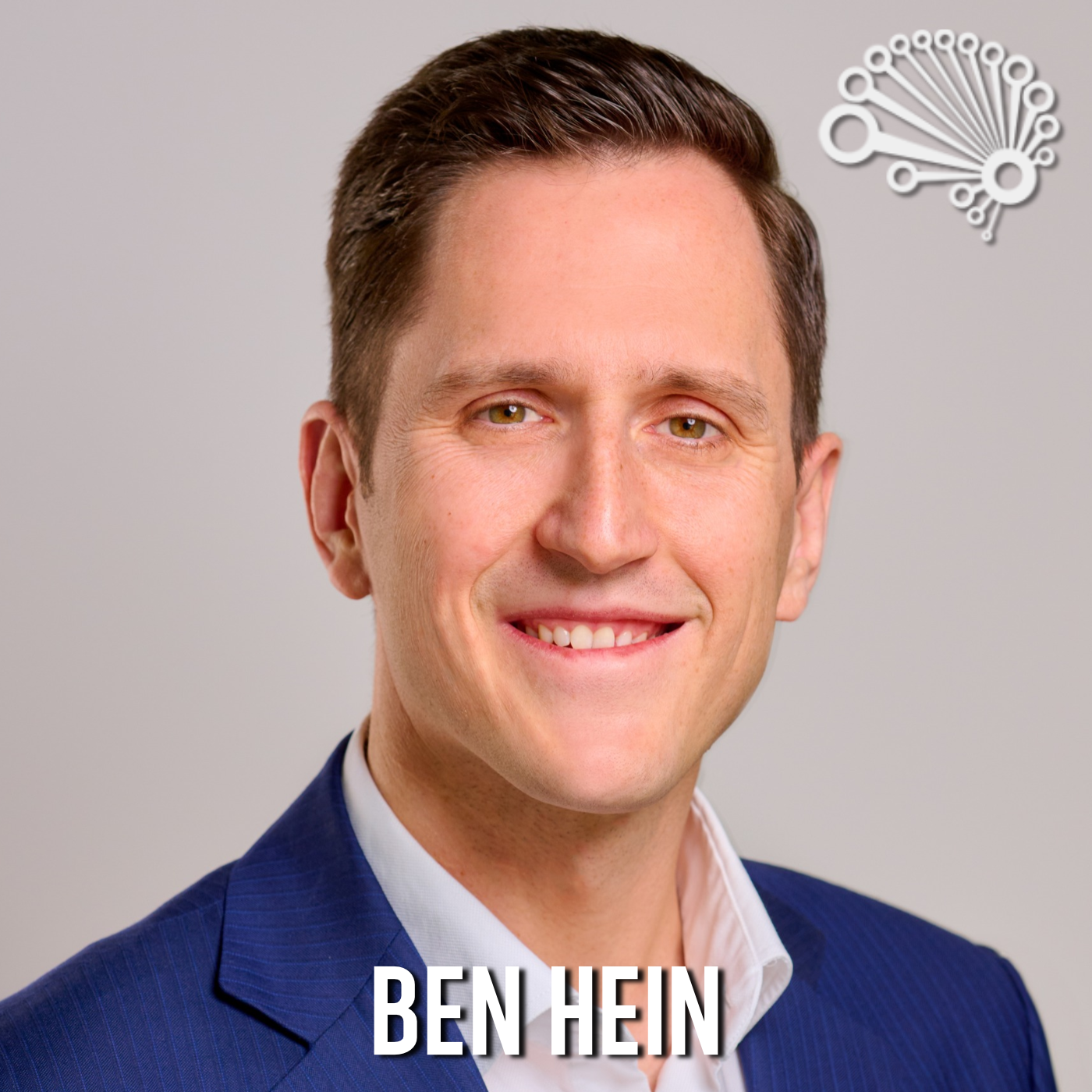
Jon Krohn: 00:00 Making a cutting edge chip is like being asked to paint one specific wall on the 57th floor of a skyscraper without ever setting foot inside the building. Today’s guest does that at the scale of individual atoms millions of times a month. Welcome to another episode of the Super Data Science Podcast. I’m your host, Jon Krohn. Today’s guest is Ben Hein, CEO of the electronics business at Merck KGaA Darmstadt, Germany, a 358-year-old science and technology company whose materials end up in nearly every electronic device on the planet. In this episode, Ben explains why chips are now going three-dimensional, how AI helps his teams throw out 85% of candidate molecules before they ever reach the lab, and why he’s optimistic that AI will make high quality healthcare affordable for everyone in our lifetimes. Enjoy. This episode of Super Data Science is made possible by Anthropic, Dell, Nvidia, Parallel, and Merck KGaA Darmstadt, Germany.
00:59 Ben, welcome to the Super Data Science Podcast. It’s great to have you here. How are you doing today?
Ben Hein: 01:04 Thank you, Jon. Doing fantastic. Really glad to be here.
Jon Krohn: 01:07 Yeah, yeah. And you’re calling in from Darmstadt, Germany, I assume?
Ben Hein: 01:11 Exactly. Absolutely.
Jon Krohn: 01:13 And so there’s an interesting thing here that we have to explain to listeners at the beginning. Whenever we refer to your company name, we have to call it by the full proper company name. This is like a requirement. It takes a long time.
Ben Hein: 01:27 It will take a long time.
Jon Krohn: 01:29 Exactly. Merck KGaA darmst.germany is the proper full name of the business. And for reasons that take too long to explain, anytime that I say the company name, I would have to say that full, Merck KGaA, Darmstadt Germany. And so probably most of this episode, I will call it your company.
Ben Hein: 01:49 Sounds good.
Jon Krohn: 01:50 So yeah, and it also makes it pretty easy to guess where you are calling in from. And like you said, it is Dharmstadt, Germany. So you recently became CEO of the electronics business at Merck KGaA Dharmst. Germany. We actually had your predecessor on the show in the past, Kai Beckman. You must know him pretty well. He was in episode number 875 about 18 months ago. And at that time he had the role that you now have. So tell us about the role that you have, how it fits into the broader company and what it’s been like in your early days in that role.
Ben Hein: 02:27 So first of all, Jon, again, thanks for having me. It’s really great to be here. And indeed Kai’s been promoted, so I’m his successor. He’s my predecessor. So really big footsteps to follow, big shoes to fill. So Merk, KJA Damstrad Germany is a global science and technology company today. We just celebrated recently our 358th anniversary. So it’s been more than three and a half centuries and we haven’t stopped changing. So we constantly adjust to the times. Today, we operate three businesses, a healthcare business, a life science business, and an electronics business, which primarily focuses on the advanced semiconductor industry. So it’s a really exciting job. I joined the company first in 2011. So since then, I had a privilege to move around quite a bit, see different businesses, different functions, different geographies. Most recently actually spent three years living in Taiwan and about three years living in Boston, Massachusetts.
03:30 And as you said, I just moved my family back to the city of Damstadt in Germany.
Jon Krohn: 03:35 Wow. All right. And it’s kind of interesting to hear. So Kai, with him being CEO of electronics before, CEO often sounds in a lot of businesses like the highest you could go, but I guess you can be promoted to CEO of the whole group.
Ben Hein: 03:50 Absolutely. Yeah. So we have three different business sectors which each have their own CEO. So I have the pleasure to run the electronics business, but then of course we have finance, we have HR and other functions as well. So indeed you could be the group chair and the group CEO. Maybe also worth noting that we’ve been in majority family ownership for three and a half centuries since our founding actually. So today the family holds approximately 70% of the companies. So they determine the long-term future and investment allocation.
Jon Krohn: 04:21 That is interesting. And to hear a company as old as that, I think something that we talked about in Kai’s episode is that it’s one of the oldest still existing companies in the world.
Ben Hein: 04:30 Absolutely. One could say it’s probably the first science and technology company. We started out as a pharmacy here in the beautiful city of Damstrad. The pharmacy still exists. So since then we obviously moved on. We’ve industrialized and we’ve entered different industries such as the semiconductor industry. So over time, we have really tried to put the customer front and center of everything we do. We’ve always made and kept our promise on quality and purity first, and we’ve always tried to commercialize and stay at the cutting edge of technological development worldwide. So it’s a pretty exciting company overall. One day you could wake up and work on rare diseases in oncology. The other day you could wake up and speed up the development of novel pharmaceuticals in the bioprocessing space. And the next day you wake up and you work on cutting edge semiconductor manufacturing. Today, I think there’s no day without opening a newspaper and reading something about artificial intelligence.
05:27 So we’re pretty proud to play our part in that industrial revolution.
Jon Krohn: 05:31 Yeah, you’re playing a huge part in it. It’s probably interesting for some listeners to hear, oh, your CEO of the electronics division, I wonder where I can get one of their stereos or one of their television sets. But in fact, the components that you make, so correct me if I’m wrong, but I think your customers are all other businesses. You don’t sell directly to consumers and you’re selling them the components for electronics. So like semiconductors and lots of other components, if I’m remembering the statistic correctly, there’s something really staggering. So first of all, the company is big. Merck KGA at Armstrong Germany has over 60,000 people globally, but even more staggering is that, and again, correct me if I get the statistic wrong, but it’s something like 99% of electronics that we could buy contain one of your company’s components in them.
Ben Hein: 06:23 Yeah, absolutely, Jon. So as you said, more than 60,000 colleagues worldwide, north of 22 billion in revenue, and there is a very high chance that we are either in your pocket or in front of you as we have this conversation right now. As I said, we focus mainly on the cutting edge parts of semiconductor fabrication, but we really support a variety of semiconductor device makers and also by the way, display manufacturers. So we’ve been a pioneer in liquid crystal technology, which now is more than 120 years old, which as you remember, fueled the display revolution a while ago. So the semiconductor industry is of course very complex and it’s got a wide range of different players in it. We are not making the chips themselves that end up in your smartphone or in your laptop. We are really thinking of ourselves as the company behind the companies that makes all of that happen.
07:18 So there are six steps in semiconductor fabrication and we are present in all six of them. So we are probably having one of the broadest offerings in the entire industry from thin film deposition materials, litography, photoresist materials, all the way down to a variety of specialty gases. But we don’t only cover the material supply, which again, some of these materials stay on the chips, some of them get actually removed as layers build up in the semiconductor device. We’re also providing systems and integrated services for our customers because as you may know, making an advanced semiconductor chip takes more than 1,500 processing steps and it could take up to six months from the day you start until the day that actually the chip leaves and gets assembled into, for instance, a smartphone, a laptop, or could end up in a variety of applications such as your car, such as your washing machine.
08:13 So think of us really as the company behind the company supplying critical material systems and integrated solutions to make advanced semiconductor chips.
Jon Krohn: 08:23 It is really interesting. And semiconductors are famously some of the most complex things ever built. And I think it’s getting more complex all the time. That 1,500 steps probably increases every few years, more and more of these steps to make even more precision, even more accuracy, even more value. It’s wild to think about and for your business, for Mark KGAA, darmst.germany to be involved in so many of those steps is pretty wild. Now obviously semiconductors are critical to the AI revolution that’s happening right now. They work hand in hand. It seems to me as maybe not the most important expert in the world on this, but it seems to me like the driving force, the biggest force behind AI advancements is in fact hardware advancements. We don’t necessarily… A lot of the neural network math has been around since the 1950s and yes, there were new ideas in the 1980s and 2010s and even the 2020s to some extent, but a lot of it is just about being able to do more compute with the same math and that’s driven by the hardware itself.
Ben Hein: 09:40 Absolutely. So we’ve really entered the era of AI. We’re not about to enter it. We’ve already entered it. So all the models that many consumers, but also companies use and deploy every single day, they need to run on hardware. So mostly AI accelerators, GPUs, and then integrated devices that have both the logic as well as the memory in one system. And we are really a critical partner to companies that make this hardware. It gets deployed in the millions and up to the billions in data centers. So when you ping your model, it needs to get processed somewhere, which happens in a data center. The majority of the market this year is actually driven by the AI segment. So data center build out. You open the newspaper, every day there’s another announcement about a data center being built, which then consumes the most advanced chips because when you ping your model, you don’t want to wait for three days until you get a response.
10:37 You want to have a conversation with your model. You want to have an immediate response. I believe we are just scratching the surface in terms of the possibilities of AI in solving really tough to solve problems and seeing mass market adoption. I don’t want to speculate where this could go, but definitely we’ve seen the industrial revolution, we’ve seen the invention of the steam engine, we’ve seen the invention of the internet, which all had groundbreaking effects on society, but also on the economy. And for sure there will be major productivity gains as a consequence of all of that. So we’ve just scratched the surface and you see the progress that’s already happening within a very, very short period of time.
Jon Krohn: 11:18 That is wild. I mean, I think a lot of people probably listen to the show to try to be keeping on top of how fast things are moving. And one of the things that’s interesting is when you are in semiconductor chip manufacturing, when you’re working in material science like you are, it isn’t just that you are advancing AI, but there’s a loop where you can then be taking those AI advances and using them to improve your semiconductor chip manufacturing and the material science itself.
Ben Hein: 11:47 Absolutely. It’s a reinforcing mechanism, Jon. And when you peel the onion, the single biggest problem that we are trying to solve right now is performance per what? So how can we improve the performance of semiconductor devices? And at the same time, how can we actually make them more energy efficient? Because all of this compute will need to be fed by energy. So there will be a scarcity of energy on the horizon. You already see areas in which data centers are being built, the power prices keep going up. So you will have the impact on consumers in particular. So we play our part in making sure that as the technology progresses, we develop new novel chemistries that are both driving performance as well as more sustainability and energy efficiency. As an industry, we are trying to bring different components closer together. In the past 50 years, 40 to 50 years, we were following something called the Moose Law.
12:45 So you try to get smaller and smaller in building ever smaller devices. I wouldn’t say we reach an end of that, so that definitely continues the innovation and front end chip fabrication manufacturing. There’s continued to be innovation, again, both on the performance as well as on the sustainability side. At the end, it’s hardcore chemistry that’s actually needed in order to make these layers and layers and structures. But then we are really trying to bring both the processing as well as the memory closer together as close as possible. So in the future, we should see a lot of growth coming from what’s called advanced packaging. So you pull out an NVIDIA chip, for example, there’s dozens of different components put onto one integrated stack, one substrate platform. So how you do that to some degree at the nanometer level, making sure there’s precision alignment that electrons can actually move in the fastest possible way on this device, but then can also be transferred out and transferred back in the fastest possible way.
13:42 It’s what’s really driving the industry’s growth, especially when it comes to AI. And what we are seeing right now, the limiting factor is not so much the compute that actually happens within a data center or within a GPU. It’s really transferring the data between different systems within one data center and ultimately back to the consumer’s hand. For example, if you use advanced AI models for your own work. So the past 40, 50 years, it’s all about getting smaller. Now it’s about getting three-dimensional and making sure you can integrate these different components in the closest and densest possible way in one system. In the future, based on this progress, what we should all expect to see is novel technologies in terms of data transmission and interfaces such as in silicon photonics. Like I said, in the past, it’s all about electrons. In the future, what we’ll see more and more is photon technology playing a key role because light simply travels at a much faster pace, so that will make it easier for us to actually have a real-time conversation with an AI model.
14:46 And in industrial applications, we haven’t even started. When you look at Europe, for example, there’s a huge industrial base. We’re actually making things in Europe. We’re making cars, we’re making chemistry, we’re making pharmaceuticals. So all of these factories are now being equipped with the technology and smart manufacturing to actually be able to adopt AI when it comes to improving yield, improving quality, but improving the overall efficiency of the manufacturing sector.
Jon Krohn: 15:13 There’s probably only so much level of detail that you can go into on that before you’d be disclosing something that you couldn’t be telling our listeners, but that sounds really fascinating where… So I suppose you’re having sensors increasingly installed in manufacturing facilities that are able to detect problems early or be able to collect data that can then be modeled in an AI model downstream to figure out where there might be some extra efficiency.
Ben Hein: 15:40 Yeah. So we won’t stop until we’ve exhausted all elements of the periodic table. There is still a lot of innovation in terms of chemistry and molecules. So if you’re studying chemistry out there, please keep studying. The world’s not ending because of AI. So there is a need for innovation. What we see is we deploy AI ourselves. We’re not just enabling it in terms of hardware. And the way we deploy it is number one, to make our whole operations more efficient. So think of process optimization. That moves the needle a little bit, but it really mainly frees up resources that we can then invest elsewhere. The second area which is a lot more exciting is on R&D. So you see materials, AI companies shooting up like mushrooms, getting really record funding. Why? Because there’s a huge need for new materials. We have a fundamental advantage as a company because we have more than three and a half centuries of experience in chemistry, ultimately in the data and integration know-how to know what is actually being done with these molecules.
16:41 So that’s huge for us. What we found as we deploy AI and R&D is we can improve our hit rate by more than 5X. What it means is we simulate before we actually go to the lab, which difference molecules could actually solve the customer’s challenge, the integration challenge. And we already take out more than 85% of the candidates. Traditionally, you would start, you would do your lab work, you would synthesize a molecule, you get tested. It takes forever. So now we can eliminate through the use of AI and modeling already 85% of the candidates that we know are actually not going to move the needle from a performance or from an energy efficiency point of view for our customers. So that really compresses the speed of innovation for us. It positions us better to work with our customers around the world on innovation. And then the job is not done.
17:30 Then you actually need to make this chemistry in very high volumes with a very high degree of quality and purity because in the semiconductor industry, as you’re building these layers and layers and you’re looking at two nanometer, 1.4 nanometer technology, every single contamination could break the entire performance of the chip. And remember, these are GPUs that could cost the equivalent of a BMW five series. So it’s massive. You really need to make sure that all of the individual components are functioning. So we’re looking not only at parts per million contamination levels, we’re looking at parts per billion, we’re looking at parts per trillion. Because of the complexity, as you said, Jon, it’s probably the most difficult engineering problem in the entire world to make a chip at the two nanometer level. And quality purity, it sounds small, but it has a huge impact ultimately on the performance, which is then why we extend the adoption of AI for us when it comes to manufacturing and predictable quality, because our customers don’t expect us to only catch up with the development.
18:34 They expect us to shape the industry’s development. So okay, we had parts per billion. How could we get to parts per trillion? At one point, there are simply no analytical methods to prove that you have this certificate of analysis. So we need to use these advanced models to simulate are we actually going to have a product that works or not? And then later on when it comes to manufacturing, we definitely are adopting, again, like you said, smart manufacturing upgrades to our plants to make them more intelligent. But once they’re more intelligent, we can actually use AI for real-time production steering and interventions.
Jon Krohn: 19:07 Incredible. We’re only getting kind of a taste of all the kinds of things that you’re doing over there. When you talk about two millimeter chips, what does that mean exactly?
Ben Hein: 19:17 It’s two nanometer liver.
Jon Krohn: 19:18 Sorry, two nanometer. Oh my goodness.
Ben Hein: 19:21 Well, you will not be able to see it with your eye. It’s a fraction of the human hair. The typical medicine, if you look at a liquid nanoparticle, it could be 180 nanometers. So this is really, really small stuff. We’re talking atomic layers. So you cannot get smaller than that.
Jon Krohn: 19:38 Basically a hundredth of a hair in width.
Ben Hein: 19:42 Exactly.
Jon Krohn: 19:42 Yeah.
Ben Hein: 19:42 And getting even smaller and smaller to the degree that we’re now thinking about how can we build these layers, these structures with individual atoms? So not molecules, but individual atoms. So it’s really the size of the structures that you’re building on these chips layer after layer.
Jon Krohn: 19:59 Gotcha, gotcha. It’s like the smallest Lego block brick size that you have to work with is two nanometers wide. Absolutely.
Ben Hein: 20:07 And you don’t only need to do that in an R&D lab, you need to do that in high volume manufacturing where you have millions of chips coming out of a fab every single month.
Jon Krohn: 20:16 Right. Yes. So this probably, it would take years potentially in a lot of cases, I have no idea, from inventing some kind of method that allows you to work at two nanometers or in the future even smaller, but then to get to being able to create all of the chips for an iPhone with that same specification, it would take years to go from the invention of the idea, being able to do it once to being able to do it billions of times.
Ben Hein: 20:44 Absolutely. It’s also a highly global industry, Jon. So no individual player can solve the entire problem on their own. It’s impossible. It’s a global industry. It’s built on the premise of globalization. You had research of all parts of the world. From the US, that’s where a lot of the chip design has originated in the Silicon Valley, to then the foundational research and technology that’s been developed in Europe, for example, on litography and the base chemistries, Japan played a huge role. So this is an industry that’s both very concentrated on a few key geographies, but at the same time, highly global because otherwise we cannot solve these very complex engineering challenges if we don’t work together across industry boundaries, across functions, and ultimately across geographies. So everybody really needs to contribute their part. And the good thing is the industry is to some degree very predictable and to some degree it’s unpredictable.
21:41 For example, about five years ago, we were all thinking by the end of the decade, the industry should hit one trillion in valuation. So we’ve already hit one trillion. We’re probably on track to hit 1.6 trillion this year because of the advent and the acceleration of artificial intelligence and the deployment of hardware mainly in data centers. You should expect that trending to continue. It’s not going to be a straight line overall. There will be bumps in the road, there will be peaks and valleys, but I think we’ve underestimated as an industry the pace of the growth and that is not expected to slow down. There will be new technologies, like you said, that have been in the works now that really find their use case. You think about topics like UV litography, it’s been worked on for decades, but it wasn’t until recently that it actually had a commercial application through ASML and the EUV machines that are deployed right now.
22:36 Definitely a very strong and very unique technology. So that’s an example where no individual company can actually make these chips in high volumes.
Jon Krohn: 22:44 Interesting. I didn’t know that UV lithography had been around so long and not in use commercially until recently. And yeah, obviously with ASML, one of the key things that allows fabs like TSMC to be able to make their cutting edge chips. I think a lot of people are aware that much of the chip manufacturing happens in Asia, and you mentioned recently living in Taiwan at the beginning of the episode. However, when we look at the entire value chain, I understand that with Merck, KGA, Darmstadt, Germany, the first step is actually mainly in the US.
Ben Hein: 23:22 Yeah, the US is really important for us, Jon. So that’s been the inception of the industry and it’s really been a very strong presence and foundation for us as a company as well. We have roughly one third of our workforce in the US. We employ more than 900 folks in innovation, mainly in R&D. And a lot of that happens in the US, in California, but really across multiple states. We have 11 sites in the United States. So that’s where the innovation really started and that’s where the innovation continues to be extremely robust and extremely strong. A lot of the process development happens with the equipment makers in the Silicon Valley in the US. So we have to be close to the process developers. We have to be very close to the device makers to ultimately participate in what does it take, which new chemistries are needed on the most advanced chips.
24:13 The manufacturing itself, as you said, Jon, this has been really strong, I think historically in Asia. So when you look at Taiwan, the very large majority of advanced semiconductor chips are made on the island of Taiwan. I would say more than 95% of the most advanced logic. You look at memory manufacturings, the high bandwidth memory that’s needed, especially for these AI chips. A lot of that’s made in Taiwan, but then also in Korea, of course, Singapore. So I would say by and large, Asia plays a really big role, multiple markets underneath, but the innovation and the origin, one could say, is really been in the United States on the West Coast in particular. And when you peel the onion, a lot of the tech companies and all the ecosystem players, the design houses that are making the designs for the next generation chips, they’re still a very, very strong footprint, especially
Jon Krohn: 25:05 In
Ben Hein: 25:06 California.
Jon Krohn: 25:06 Yeah, really interesting. Not necessarily something I would’ve expected even after my interview with your predecessor, Kai Beckman, a little over a year ago. So that is a new piece of information for me. How about half of our listeners come from the US, so I suspect we would have some listening out there who are getting their interests piqued by such an interesting company as yours and the opportunities there. AI is obviously transforming our world when it comes to semiconductors. How does AI… We’ve talked about AI at a relatively high level in how it can be used within materials manufacturing. Is there anything that you specifically have to add around the next generation of chips? How does AI drive the development of the next generation?
Ben Hein: 25:51 Yeah, so the next generation is not going to be about volumes of wafer output. It’s really more going to be about the complexity and the compute power and energy efficiency of the entire system. So that’s what we call advanced packaging. Individual chips such as memory, they’re going to move more three dimensional because ultimately the surface on which they’re placed on the wafer is limited. So everything’s much like a skyscraper. Think of a traditional village, one story, maybe two stories. Now it’s really going three dimensional. And the challenge of actually making these individual chips is think of the Type A 101, for example, or any large skyscraper that comes to your mind. What if somebody asks you from a distance, so you cannot actually enter the skyscraper, you need to paint the wall of the 57th floor in the first apartment on the left with a very high degree of accuracy.
26:51 How do you do this? So that’s the type of challenge that we are facing, especially as things get more three-dimensional. We call that atomic layer deposition and selective deposition as well. So you’re only supposed to paint this one wall green. You’re not supposed to paint the other one blue and the other one black, and you’re not supposed to spread the green all over the place. It’s got to be pretty accurate. And this is a challenge we’re facing at the atomic level, so it cannot really get smaller than that. If we manage, and we’re doing a pretty good job as an industry to actually make these chips, 200, 300, 400 layers of chips on one of each other, we are doing pretty well. But then the next challenge is going to be how do you actually integrate this? How do you bring the logic processor as close together with the memory chip as possible so that you decrease the time that it takes to transfer data?
27:41 Okay, so we solve that, for example, with advanced packaging. The next challenge that you’re facing is heat, because there’s a really high amount of processing that happens on a very small system. How are you going to actually manage this heat? So we need new chemistries, new solutions for thermal management to make sure that the chips are not overheating and at the same time can actually do that job. So there are newer and novel chemistries that are solving some of these most advanced problems, especially in semiconductor manufacturing. And let me give you one example. Molybdenum is a metal that’s been researched and that’s been used for several years, but it hasn’t really taken off in terms of commercial adoption. Now the industry, we together with the toolmakers, the device makers, we have really figured out a way how we can use molybdenum in high volume manufacturing.
28:31 And it’s going to replace, it’s already replacing. Now we are scaling things up as an industry, traditional molecules such as, for example, tungsten as an element. So we can be faster in the most advanced compute and we can be at the same time more selective in how we build these chips. So that’s an example of a technology transition that we are just about to see, and that’s going to get really big very quickly over the next couple of years.
Jon Krohn: 28:56 Molybdenum, not a element that you hear every day, at least that I don’t hear every day. Maybe you hear it every day. But yeah, for our listeners, it’s in the periodic table of elements. It’s got atomic number 42. Yeah, it’s so interesting to hear.
Ben Hein: 29:13 More molybdenum. Yeah. You use it to make interconnect layers, for example.
Jon Krohn: 29:18 It’s wild how you get to dig deep into this stuff every day. For our listeners to understand, if they want to have a role like yours where they can be understanding so much end to end in semiconductor manufacturing, what’s your background and what do you recommend for people that want to be able to have a position like you in the future?
Ben Hein: 29:42 Right. So first of all, my background is in business. I took the wrong turn when I left high school. So that’s one of these regrets you have, but then there’s no easy way, Jon. So you just got to work really hard. You got to be curious about the technology. There’s a lot of things that you cannot know Because the industry is very complex, I would say really be humble, be curious about the technology, know that you’re never going to be an expert in everything. I think that’s really important. As I said, there’s no easy way. So what really worked well for me is to spend a lot of time in the R&D labs talking to people, really digging into the depth of the technology, making sure I understand how it works and how it connects. That’s number one. Number two, nowadays with AI, you can do a lot of self-learning.
30:31 So please learn, use these tools for your self-development. That’s the best you can do. If you don’t know anything about molyptonum, you don’t know anything about advanced semiconductor fabrication, use any advanced AI model. You can learn a lot in 30 minutes. Have a conversation. Maybe some of you guys have your own agent already. Talk to your own agent, talk to yourself. I think that’s really good. Works quite well. And then I spend a ton of time talking to customers. That’s probably the most valuable source of information to really understand where are they heading? Where’s their technology roadmap going? What challenges are they facing? Besides making things work in HVM, high volume manufacturing, what are the technical issues that they’re trying to solve and what’s on their roadmap? The good thing is, like I said, some technologies have been researched on, but maybe not at a commercial scale for some time.
31:22 So the good thing is the technology roadmap of the semiconductor industry is quite transparent. So if you really research that, where could it go? How about the next generation logic, next generation memory, what’s advanced packaging, what’s silicon photonics, what’s the 40-year roadmap? You maybe don’t get 100% clarity, but it gives you a pretty good view on where things are headed. And sometimes as we’ve seen with UV, for instance, some technologies take off like a rocket and others get maybe deprioritized. It depends a bit on what’s the end application, what’s ultimately actually going to be done with these chips. And up until recently, AI wasn’t around. So really what people did with all these chips is they used them in the most advanced smartphones. They used them in the most advanced laptops. They used them for gaming. They used them to get their work done. And fundamentally, more and more devices are getting intelligent.
32:16 We all know our washing machines, I assume most of your listeners, they’re in the age that they actually have a washing machine that’s equipped with semiconductor devices. If I ask my parents or my grandparents, they don’t understand what I’m talking about. So that’s a good example for where more and more hardware is becoming intelligent and ultimately equipped and that trending you should all expect to continue. So we are talking about data centers. The next generation is going to be all about robotics. And then after that, how can we actually deploy what we’ve learned through AI in healthcare applications? Because the biology of things is not really well understood. It’s very easy to predict what happens on the chemistry side and maybe on physics, but on biology, there’s still so much that we simply do not understand how the human body functions. So ultimately, we may experience that in our lifetime, we actually be able to cure most diseases that are around.
33:13 We actually be able to solve most of the manual labor challenges through the adoption of robotics and AI. So that’s been my experience, how I got into that space and how I continue to learn. But honestly, Jon, it’s a journey. It’s changing so rapidly that you constantly have to stay on top of it.
Jon Krohn: 33:30 That was a fascinating tour into what the future could look like. And it reminds me of a conversation that we recently had on the show with a brilliant AI researcher and entrepreneur, one of my favorites ever, a guy, Dr. Richard Socher. He’s actually, he’s German originally himself, so Socha, but he’s been in the US so long that even I asked him before we started recording the episode, I was like, “Do you want me to pronounce it in kind of a German way?” He was like, “Nobody does. I should just say Socher.” So Richard Socher, he was on the show in episode 1037 about a month ago, and he was talking about his, at that time, brand new national bestselling book, The Eureka Machine, because his company, Recursive, has raised over half a billion dollars despite only being a year old to bring about recursive self-improvement and artificial superintelligence.
34:22 And he thinks that this will make big advances in how quickly… It could be anything from material science that you focus on at your business to biology. And so it reminds me of how… So you were saying how in chemistry things are so much better understood or maybe in physics, things are so much better understood. And Richard made this case that things that we historically think of as just a science where we’re trying to understand how biology works, that biological engineering becomes more and more and more prominent than biological science as we start to understand it better or as machines help us understand it better.
Ben Hein: 35:05 Absolutely, Jon. Yeah. First of all, I should get a copy of his book. Sounds really interesting. I fundamentally agree that there is a convergence of different fields and different disciplines, especially biology, chemistry, and physics. We see that as a company converging more and more where people thought that they were at the limit of what they could contribute, for example, in physics through our display technologies way back then that now find totally different value when they look at semiconductor related challenges. So there’s a convergence of different fields. There’s also a convergence of different industries. I mean, remember when we were founded in 1668, there was technically no definition of all these industries. There was no chemical industry, there was no pharmaceutical industry, no semiconductor industry. So there’s a creation of, I think, new industries and there’s ultimately a convergence as well. When you think about topics such as bioelectronics, so human sensing and ultimately treatments, there are some first encouraging examples, but that’s a trending that we should all expect to continue as we look into the future.
36:15 And with the tools such as AI, we’ll be able to understand much better the human body.
36:21 I’m sure most of you know somebody who suffered from a really difficult disease, may have recovered, may have passed away. It’s really frustrating to see all of the progress we made in society in these different industries, but at the end of the day, we know so little. There’s still not enough optionality for patients that are suffering from really difficult to treat diseases. So we feel like there’s tremendous opportunity for us as a company to make a difference. And that’s why if you look at us, you wonder, why do these guys have a semiconductor business and why do they have a pharmaceutical business and why do they have a life science business? I believe eventually there’s more and more convergence and we feel super well positioned to tackle some of these problem statements.
Jon Krohn: 37:04 Yeah. I’ve recently been dealing with a critically ill family member who she’s been in hospital care for months now, so my 96-year-old grandmother. And it is interesting to see… She lives in Canada, which is a relatively advanced, relatively wealthy country. And even there, the amount of decision-making intelligence that is provided to her on any given day, we’re talking minutes of the physician being able to come around and look at how the labs are going, lab results are going, and okay, should we make some adjustments or what’s really happening here? What’s the root cause? They only have a few minutes a day per patient.
37:56 I can’t even imagine if you’re in… There’s lots of people all over the world who won’t see a physician in their entire life. And it seems obvious that having that experience with her in the hospital, I was like, well, hopefully we’re not too many years off from being able to have AI systems be providing guidance to the physicians, to be having much more breadth and depth of cognition happening on each individual patient. And yeah, it can make a huge difference to people who are able to see a physician like she is, but then there’s billions of people on the planet who don’t have access at all. And as you’re saying, people might have some rare disease or some difficult to treat disease, but theoretically in our lifetimes, it could end up being the case that we have these more and more automated pathways. Maybe there doesn’t even need to be a physical physician in the loop, but some kind of pharmaceutical solution can be developed for this individual.
38:55 It’s pretty wild to think what could happen, and maybe that kind of all ties back to the 350-year history of your business and its roots in pharmaceuticals.
Ben Hein: 39:05 Absolutely, Jon. I think, knock on wood, there’s a pretty high chance that in our lifetime, everybody in the world is going to be able to enjoy really high quality healthcare at affordable cost. Like I said, today, some get treatment. It might be very expensive, but at least there is optionality. In the future, I think it’s just going to be universally accessible because it’s going to be so affordable and all the models that we are seeing today are going to mature big time. The first applications I think are going to be more about pattern recognition, so diagnosis and detection of diseases, which honestly is a phenomenal study. We were able to diagnose everything that’s happening in our body, and if it goes the wrong way, we know that instantly rather than years later when it’s maybe already too late, because then we can take early action to actually treat things like cancer before it takes a direction that’s simply going to be very hard to cure or control.
40:04 I think there’s a very high chance that, first of all, all these data sets and sources are going to be integrated so that physicians can use their time more smartly instead of being overloaded by a variety of patients, variety of issues, they will get more of a hint. So I don’t believe AI will replace physicians, for example, but it will help them to be a ton more productive and actually doing their work, diagnosing, but then also treating the patients versus maybe tapping in the dark, having some bits and pieces of information. I think it’s pretty encouraging. Like I said, I’m an optimist. I don’t believe that we’re going to see that downside scenario of AI. I think humanity is really going to figure out the best use for that technology. While of course we shouldn’t be naive, we need to think about what are the right boundary conditions in which we are deploying and evolving, especially the software side of things.
Jon Krohn: 40:57 And so of course, as we’re just describing, you and I are big believers, and you don’t even need to be believers in the future. You can see today that the pace of innovation across industries is accelerating. When it comes to the future of semiconductors, how does AI impact your approach to innovation and ensuring that we’re keeping up with that speed?
Ben Hein: 41:18 Yeah, I think we and our industry remains in a highly transformative state, so that’s not going to change. In fact, I think it’s going to accelerate. In the past, say 10 years ago, when I met with customers, they would tell me, “We introduce a new innovation every three to four years.” When I meet with customers now, for example, on the memory side, but also on the logic side and on the integration side, they would introduce a new system, a new chip pretty much every single year. So what we see is more diversity in use cases because you simply cannot use the same hardware for every single problem. So there’s more customized chips. These customized chips need new process know-how, new process integration, and ultimately also new materials depending on the problem that you’re trying to solve. Neuromorphic is already here. So we are trying to understand what’s the brain actually doing?
42:13 The brain runs on approximately 20 watts, and it’s doing a pretty good job. I would say AI is maybe more intelligent in terms of solving cognitive problems and general pattern recognition problems compared to the human being, but our brain is pretty good. So there’s already technology out there that can simulate parts of what the brain is doing. For example, when you think about agriculture, you don’t need to always have two nanometer chips monitoring participation or what’s happening with your crops or what’s happening with the sunshine or so on. You could simply have a system that gets activated when it needs to be activated and then it steers whatever has to be steered, like for example, watering. So that’s what I think we should expect moving forward. There will be more diversity of technology. I think technologies are going to be actually additive. There is no scenario where conventional logic chips or memory chips are going to be completely replaced by neuromorphic or by quantum computing.
43:15 But if you think about something like neuromorphic or quantum computing, it will add to everything that we are seeing already today, and it will be able to solve very specific, unique challenges in a much better way. So what it means for us is we have to be faster, we have to continue to innovate, and I believe we have to continue to move even closer together as one industry. So it’s not just about the iteration or innovation model of the past where every six months you ship a sample, it gets tested, every four or five years there’s maybe a new innovation coming out. It has to be much faster. So all of us have to step up the game. The reality is also in the semiconductor industry, everybody’s a choke point. So especially if you have a leading role in the industry, you really need to make sure that, like in a concert, but it’s a concert of thousands of different musicians, everybody really needs to play their part.
44:09 So that’s why collaboration, again, within the industry, but also across geographic borders is absolutely essential for us. And we believe the future is absolutely bright when you look at it. 13 years ago, we basically had no semiconductor business. Today, we’re three and a half billion euros, majority of that sets into advanced semiconductor fabrication. But what we have to do is what we’ve done for the last three and a half centuries, constantly challenge ourselves, reinvent ourselves, put our customers and our people front and center of everything we do, and then we’ll be able to succeed much like we’ve done in the past years.
Jon Krohn: 44:45 And it seems like having your business involved across the entire semiconductor manufacturing process gives it a unique advantage relative to competitors perhaps.
Ben Hein: 44:54 Yeah. We really believe that you cannot be successful or relevant if you only provide one product. That’s not how it works because then you’ll need to collaborate with thousands of individual companies. So we offer both a really broad portfolio that spans all the six manufacturing steps of wafer processing, but we are also supplementing that with equipment systems, but also services needed to solve a very specific challenge. So in the future, that will come in quite handy, that combination of materials, equipment, metrology and inspection, but also process understanding so that we can be an even better partner to our customers as they continue to innovate. And by the way, innovation doesn’t happen only in one place. It’s going to be a global corporation. We’ve always followed a local for local approach. We want to use our global capabilities across more than 34 sites in the world, like I said, 11 in the United States, but then we have to really execute locally because if a customer needs a sample of a new chemistry, you can’t wait a couple of weeks until you put that on a boat from one location and ship that to the other.
46:02 It has to be all happening within a one or maximum two mile radius so that things can actually move much faster at a faster speed. You have to collaborate in language, in culture to ultimately make the progress. It’s really about the speed and making sure that we can bring a combination of different solutions to our customers to solve their workflow problems.
Jon Krohn: 46:22 Yeah. Speaking of speed, we talked about, or you talked about a few minutes ago, some of the advantages of artificial intelligence relative to human intelligence. But my understanding is that you personally believe that people remaining at the center with AI multiplying our brain power as opposed to replacing us is a key part of how your business will evolve and probably a lot of businesses should evolve.
Ben Hein: 46:48 Absolutely. Again, I’m an optimist, so I don’t believe in all these doomsday scenarios that are out there in the news every day. I think we will figure this out. We’ll figure it out as society, we’ll figure it out as an industry, and as a company, we believe in actually augmenting our people. Think about it. If you’re an R&D researcher, in the past you spent month and month and months synthesizing different chemistries to then be able to test them and figure out 99% are actually not working. So now you can skip 85% of that work and you can go straight to the chemistries that actually make a difference when it comes to the process integration and the application of it. Our people love it. Not everybody loves it equally, but just the fact that we are augmenting the expertise and we can get rid of non-value added work or manual laborious work that actually makes no impact on our customers, on our business, generally people appreciate that so they can spend their brainpower, reinvest their brain power on higher value added activities.
47:52 I think maybe another way to look at this is when the industrial revolution happened or when the internet actually came about, I think likewise, people were expecting it’s the end of it. Now there’s going to be major productivity gains. What are we going to do with all the people? What are all the people going to do? Are they going to have jobs? Are the jobs going to go away? When you look at the statistics and the numbers, every single one of these errors, people went out being actually more productive and not less productive. I haven’t heard of 99% of the people now lying on the beach around the world, not knowing what to do because of the internet or because of the industrial revolution. The human mind is really made to be curious, to think about what else could I do? How can I explore the next frontier?
48:42 And good thing is everybody has different passions, different industries. You could continue to get into technology, you could get into arts, you could get into culture. So there’s still a lot that you can do with your time. And I think after we’ve seen really the full spectrum of the I era, there’s going to be an improvement, significant improvement in productivity. And we see that translating not in terms of efficiencies, but in terms of how we investing the resources to create more value when it comes to innovation, when it comes to quality, when it comes to manufacturing, when it comes to supporting our customers worldwide. So I see that as a major opportunity, not just for us, but really for all companies around the world.
Jon Krohn: 49:23 Fantastic answer to a great interview. Tons of optimism. You’re very aligned with me on that. And yeah, congratulations again, Ben, on becoming CEO of the electronics business at Merck, KGAA Darmstadt Germany. And yeah, hopefully we can have you on the show again in the not too distant future. I learned so much from you today, and I’m sure our audience did as well. In between today and your next appearance on the show, what’s the best way that people should be following you or following your business?
Ben Hein: 49:59 Thank you, Jon. First of all, really appreciated the conversation. Let’s stay in touch. I try to be active on social media. Right now, customers push me left and right as we are in a major demand surge and a super cycle in the semiconductor industry. So LinkedIn is a really good way to stay in touch. Otherwise, just drop me an email. Happy to stay in touch with all of you.
Jon Krohn: 50:20 Wow. What an offer to make. Okay. Thank you so much, Ben, for taking the time out of your busy day for me and for our listeners, and hope to catch you again soon.
Ben Hein: 50:29 Thank you, Jon. Have a great day.
Jon Krohn: 50:33 Absolutely gripping episode today in it. Ben Hein detailed how Merck, KGAA Darmstadt Germany supplies materials, systems, and services across all six steps of semiconductor fabrication, a process with more than 1,500 individual steps that can take up to six months for a single chip. He talked about how the industry’s single biggest problem is performance per watt, because all of this compute has to be fed increasingly scarce energy. How after five decades of making chips smaller, the frontier is now making them three-dimensional and packing logic and memory as tightly together as possible with light-based silicon photonics coming next. How AI-driven simulation lets his R&D teams eliminate 85% of candidate molecules before any lab work improving their hit rate more than fivefold, how molybdenum is starting to replace tungsten in the most advanced chips, and why he believes AI will augment people rather than replace them, and that we may see universally affordable, high quality healthcare within our lifetimes.
51:30 As always, you can get all the show notes, including the transcript for this episode, the video recording, any materials mentioned on the show, the URLs for Ben’s social media profiles as well as my own at superdatascience.com/1045.
51:43 That’s because today is episode number 1045. I hope you enjoyed it. And if you’d like to engage with me in person as opposed to just through social media, I’d love to meet you in real life at the Open Data Science Conference’s AI for Work Summit running from December 2nd to 3rd in Midtown Manhattan. It’s a conference focused on building AI agents and applications for your everyday work. There will be workshops for hands-on practitioners as well as no-code workshops for more business-oriented folks. I’ll be delivering the opening keynote on how to thrive in the agentic AI era. I hope to see you there. All right, thanks to everyone on the Super Data Science podcast team, our podcast manager Sonja Brajovic, media editor, Mario Pombo, our partnerships team Natalie Ziajski, our researcher, Serg Masís and our founder Kirill Eremenko.. Thanks to all of them for producing this super episode for us today, for enabling that super team to create this free podcast for you.
52:34 We are deeply grateful to our sponsors. You can support the show by checking out our sponsor’s links and you can head to JonKrohn.com/podcast if you’d ever like to sponsor an episode yourself. Otherwise, please help us out by sharing this episode with folks who are fascinated by how AI chips are made. Review the podcast on your favorite podcasting platform or YouTube. Subscribe if you’re not a subscriber, but most importantly, I hope you’ll just keep on tuning in. I’m so grateful to have you listening, and I hope I can continue to make episodes you love for years and years to come. Until next time, keep on rocking it out there and I’m looking forward to enjoying another round of the Super Data Science Podcast with you very soon.