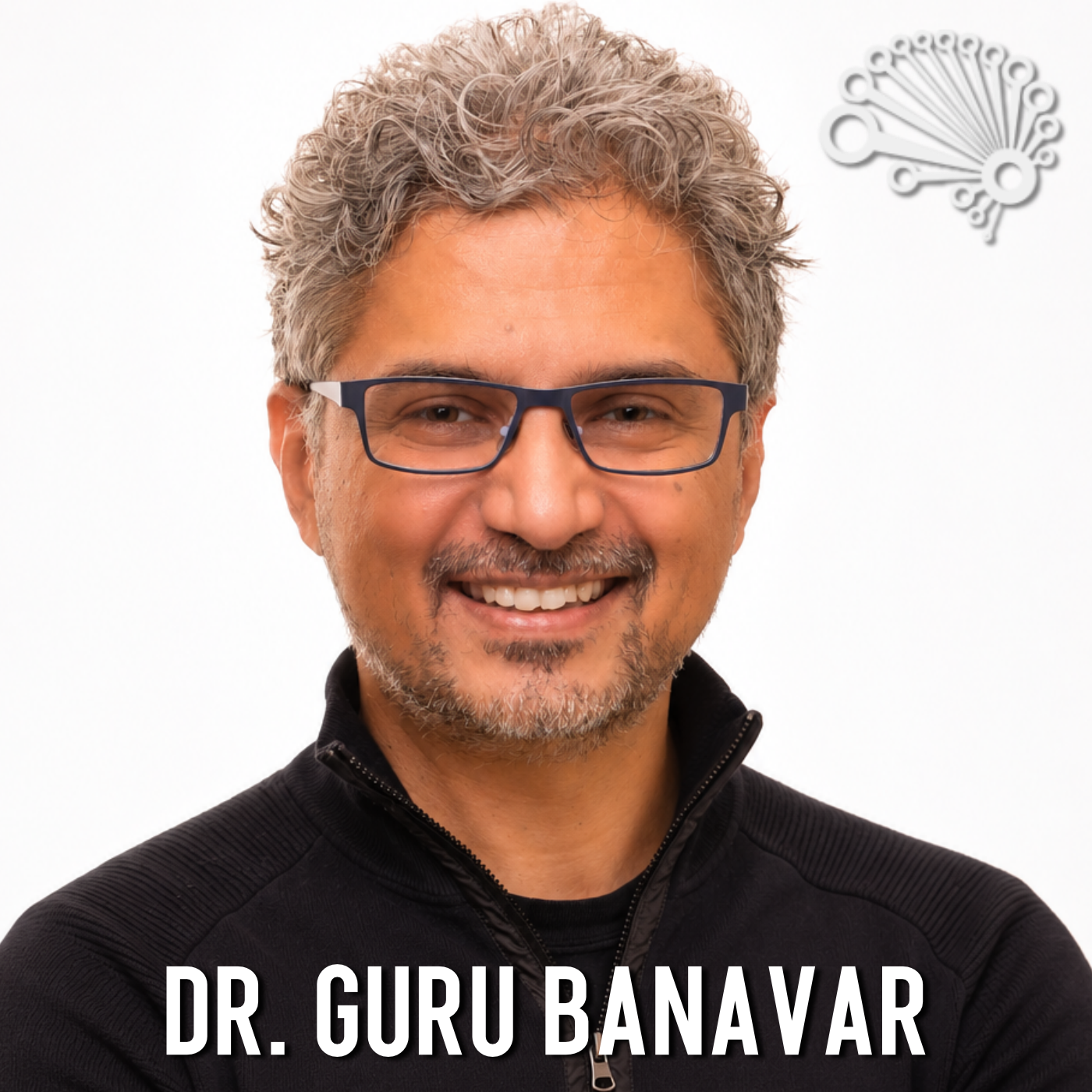
Jon Krohn: 00:00:00 Broccoli is a superfood, right? Well, not for everyone. For some people, it’s a food to avoid. And today’s guest has the data to tell you which group you’re in. Welcome to episode number 1043 of the Super Data Science Podcast. I’m your host, Jon Krohn. Today’s guest is Dr. Guru Banavar, co-founder and CTO of Viome, a precision health company that has built what Guru describes as the largest data set on human biology ever collected. About a thousand quadrillion nucleotides of RNA from people in more than 150 countries. Before Viome, Guru was the first VP to lead IBM’s Watson AI team. In this episode, he explains why RNA rather than DNA is the key to preventing chronic disease, how Viome’s models predict which foods will spike your blood sugar, and why keto dieters look biologically older than vegetarians. Enjoy this interesting episode. This episode of Super Data Science is made possible by Anthropic, Dell, Nvidia, and Parallel.
00:01:01 Guru, welcome to the Super Data Science podcast. How are you doing today?
Guru Banavar: 00:01:05 I’m doing great, Jon. Thank you very much for having me.
Jon Krohn: 00:01:08 We are delighted to have you on the show. When I saw that somebody from Viome could be on the podcast, somebody with a technical background like yours, we snapped up the opportunity, got you on as quickly as possible. I think an important place to start is what is Viome, the company that you work at today?
Guru Banavar: 00:01:23 Yeah. Well, Viome is something that I co-founded with a couple of my colleagues. The basic mission and the realization I had about 10 years ago was that chronic disease is such a prevalent thing. Everybody that I know has some kind of chronic disease and I think 70 or 80% of the population of the world has a chronic disease. The problem is that our healthcare system does not really focus too much on the prevention of chronic disease. Because once you get into a chronic disease acute state, you end up having a low quality of life. You end up basically living through the rest of your life in some kind of a weird situation. You could be highly restricted in your activities, highly restricted in your diet, highly restricted in the kinds of experiences you can have. So if we want to have a long, healthy life, which is what we call a health span, a long health span, what we need to do is be aware of our biology and prevent these chronic diseases.
00:02:34 That was the impetus for us to start Vio. So what we’ve done now in the last 10 years or so is we have collected the largest data set of the underlying biology of human beings, human beings, not animals, which is what a lot of medical researchers and biological researchers do, but we’ve collected human data for the largest collection of people across the whole planet, which is more than 150 countries or something around the world. And so with that data set, we are able to understand biology at a level of resolution that we’ve never been able to do before as humanity. And we have a lot of scientific publications to support this. And because we have that kind of data, we are able to provide really great insights to people about their own biology. We are available direct to consumer or through your doctors as a test that you can send your samples in from home and you can get back these insights about your biology and then also recommendations for your nutrition and other lifestyle factors.
00:03:44 And hopefully that will give you an early indication of any chronic disease risks you have or development of those diseases so you can live a long, healthy life. That’s what we do at Viome.
Jon Krohn: 00:03:54 Yeah, I’ve been familiar with Viome for years because my sister was a huge fan of the business and she loved the results that she got. She thinks that it makes a big difference. So this idea of – Thank you. So you take a… Well, there’s a stool sample, which is a fun one to provide. You provide a saliva sample. What’s the third sample?
Guru Banavar: 00:04:15 It’s a blood sample. It’s actually a finger prick blood.
Jon Krohn: 00:04:19 Yes, yes, yes. I remember it’s like some people, I think the blood gets flowing easier than others. I was one of the tricky… I had this tricky experience getting enough blood to flow.
Guru Banavar: 00:04:30 I know. I know what you mean. Now there are easier ways to collect blood than there were even a few years ago.
Jon Krohn: 00:04:35 I bet, no doubt. But yeah, so I’ve done that. I’ve gone through it providing these samples to you. So you get this little kit, you get a little rectangular box in the mail and it has instructions for how to… Oh, we’ve got one on screen. Yeah, exactly. For people watching the YouTube version, they can see it. So it’s kind of like a Kleenex, kind of like a flat Kleenex box and it’s got instructions inside of it for how to provide the stool sample, how to provide the blood sample, how to provide the saliva sample. And then you send it back to biome.
Guru Banavar: 00:05:10 It is very easy. I just want to say it is very easy, right? I mean, you just have to get over a little bit of a psychological barrier for doing these things, which a lot of people, they’ve not done something like this before. But once you get past that point, the three samples are actually very important that we take three samples, Jon. We’ll get into it hopefully about what the biology of that is and all of that stuff and what the data looks like and what the AI looks like behind it and all that.
Jon Krohn: 00:05:36 Let’s dig into it. But at a high level, the idea is that it gives us a great sample of what the microbiome… So for listeners that aren’t aware, you’ll know these data better than me. So our body is composed of how many billions of… I mean, I guess trillions because we have 90 billion brain cells alone. So yeah, we must have trillions of cells in our body, but then we also have even more microbiome.
Guru Banavar: 00:06:07 1.3 microbes per every human cell in your body at this point in time. That’s what we think it is on average. But more importantly, to be honest with you, you have to not just count the number of cells, you have to count the number of genes. So a typical microbe may have a few thousand genes. So the human cell DNA has approximately, let’s say 20,000 genes. But the total number of genes in your overall microbiome in your entire system is like a hundred times that. So it’s like two million genes. So the biological code in your body is like a hundred X of what your human biological code is. So the critical thing that we made a decision to do is to not just look at the human cells and the human DNA and the human genes, but also look at the microbial cells and the microbial genes and then put the two together.
00:07:05 So there’s a huge amount of evolutionary interaction that happens between the microbial genes and the human genes. So it’s all this biochemistry that’s happening in your gut, in your mouth, in your blood and so forth. Every time there is activity in your microbiome, there is a corresponding activity in your human cells and it actually is a symbiotic relationship. There’s a lot of good things that happen on both sides because we become a large vehicle for all of these microbes to ride along in because they’re getting the food they want, they’re getting the home they want, all of that stuff. But we get a lot of things back from them. We get very good anti-inflammatory signals, we get vitamins, we get all kinds of things from them. In fact, we know that if somebody does not have a healthy microbiome, they get sick very, very fast.
00:07:57 A baby inherits more genes from the microbiome of the mom than the human genome of the mom, if they have a natural birth. If they have a natural birth,
Jon Krohn: 00:08:09 Right? Okay. Given the hundred X multiple, that’s unsurprising. And very interesting because with what you’re saying, we basically… So Viome has collated research from I guess probably every paper you can find related to the microbiome so that you can make associations between these samples that we provide and you can say, “Okay, given this particular microbiome profile that you have,” and you could maybe tell us more about how that profiling works, but based on that profile, we will make recommendations to you in terms of your diet, in terms of your lifestyle to have your microbiome look a bit more like the microbiome that the literature suggests is healthiest, whatever that means. I guess maybe you’ll have to tell us how you define what
Guru Banavar: 00:08:59 A
Jon Krohn: 00:08:59 Healthy person is and how that becomes a target.
Guru Banavar: 00:09:02 Yeah, happy to do that. So the most critical thing to understand is that the genes, meaning the DNA molecules in both your human cells and your microbial cells are basically static. So just think about your own genes. So in your genome, let’s say you have 22,000 genes. So you inherited those genes from your parents, correct? When you were born, you had these 22,000 genes. And when you die, you have the same 22,000 genes. The genes don’t change over the course of your life.
Jon Krohn: 00:09:37 Yeah, not in a systematic way. Yeah. There’s random mutations, but they’re not –
Guru Banavar: 00:09:40 There’s random mutations, but there’s also mechanisms to fix those mutations. That’s why you actually have redundancy in the genome, right? So if one of them gets mutated, the other copy gives you the blueprint to actually fix the one that was mutated. So most of the time it gets fixed unless you inherit in your germline, you inherit a mutation that may cause a genetic disease. And there’s few genetic diseases. There’s maybe 10, 15, 20% of the total number of human diseases are genetic diseases because you inherited a mutation and you cannot do anything. You cannot fix it because both copies are mutated and you got it from your ancestors and you cannot do anything about it. But guess what? 80% or more of human diseases are not genetic diseases. They are chronic diseases which happen not because of DNA, but because of which genes are expressed, meaning which genes turn from DNA into RNA, which in the overall sort of axiom of biology, you go from DNA to RNA to proteins and then eventually downstream you go to metabolites, which proteins and metabolites are the ones that are actually doing the biological work.
00:10:59 But the point is, if you want to understand biology, people thought until very recently that DNA is the right way to look at things, but we thought that that’s not the right thing to look at because it’s too static. What you need to look at, you can look at the proteins, which is all the way downstream, but guess what? There’s like a half a million or more proteins and it’s very chaotic. It’s very dynamic and it’s too much data to understand biology. So don’t be too static, don’t be too dynamic. What’s the right thing? It’s the RNA. RNA is the precursor of proteins because a protein wouldn’t happen unless you had RNA gene expression from the DNA. So we decided that we would focus on RNA and that’s a huge scientific decision by the way. Most people, like 99.9% of biotech companies would not focus on the RNA.
00:11:55 So we had to actually focus on a new molecule that we had unique IP for back 10 years ago from my co-founder, the chief science officer who came from Los Alamos National Labs who had worked on RNA technologies for years and years and had developed the basic laboratory assays, the wet lab assays that can isolate the RNA molecules and convert them into sequencing data, which is called RNA-seq. So that is a fundamental decision we made. And that decision about focusing on the RNA is critical for understanding chronic disease, by the way. So I’m going to get back into your question about what is the microbiome profile of a healthy person versus a diseased person.
Jon Krohn: 00:12:39 Yeah. Just to quickly interject, to give listeners kind of an idea, I think you did a great job explaining this fundamental biological principle of DNA being transcribed, being copied to make RNA, and then those copies giving the blueprint for how proteins should be structured and the proteins are actually the things doing the work. The way that I’ve always thought about RNA is if you try to have some kind of biological mechanism without the RNA in the middle, it couldn’t possibly work because in most cases, you only have one copy of how the protein should look in the DNA. And in practice, lots of proteins, you’re going to want lots and lots of copies of them. So you need some way of photocopying the DNA to have as many photocopies as you’re going to need to produce the number of proteins that you want in a given cell or in a given individual.
00:13:33 And so the RNA is like these photocopies. And so it gives us a great sense, a great picture at any given time point for any given tissue as to how genes are being expressed because we can count roughly how many photocopies of that gene are being made available.
Guru Banavar: 00:13:51 Exactly right. Exactly right. So the photocopies that you mentioned are the number of transcripts. So some genes are expressed tremendously. They may be like hundreds or even thousands of copies made, whereas some other genes are silent. There’s zero copies made. So when someone says that you have an organism in your microbiome, let’s say you have an organism like Akkermansia eucinophila, it has 3000 genes. You don’t know which of the genes are being expressed at what level and which are the genes that are silent. And it turns out that if the genome over here, think of a genome as a long chain, but if the genome is expressed down here, Akkermansia eosinophilia can be harmful to you. I mean, it can go all the way to, let’s say, multiple sclerosis and those kinds of diseases. But if it’s expressing down here in the genome, it can actually be beneficial for you.
00:14:53 So it can actually be producing short chain fatty acids, which are anti-inflammatory, which can actually help you with chronic disease. So knowing that you have Akkermansia, eosinophil in that whole genome is not very useful. What you need to know is, is this part of the genome being expressed or this part of the genome being expressed? Because depending on what is being expressed, you can tell whether there is a disease potential or disease activity happening or whether you’re going to be healthy because you’re doing that. So it can actually flip from one role to a different role. I tell people, it’s sort of like you can have a human being in a good environment and they act good. You can have the same human being put in the bad environment, they can act bad. So it’s not about what you are born with, it’s about what your behavior is, what you express in the environment that you’re in.
00:15:47 So that’s basically what’s going on with microbes as well. So to come back to your question about what is the microbiome profile, what we decided to do was we take the gene expression, the RNA molecules of the human cells in your body through your blood and through the lining of your gut and the lining of your mouth. And then we take the microbial gene expression, which is in your gut and in your mouth. Gut has the maximum number of microbes as far as we know in the body. And your mouth is the second largest one. So we decided that you get the microbial activity in your gut, the microbial activity in your mouth, and the connections to the human side, which is through the blood. Because we have those three samples, we get this full picture, top of the tube, bottom of the tube, around the tube, and we also understand the gene expression that’s going on.
00:16:38 So that’s why we are able to kind of develop, you could think of it as a biological snapshot of your entire body. In the biology world, they call it a systems biology view of your entire body. That’s why we have the three samples, stool, blood, and saliva, because we can get a systems biology view of you. So we’re not just looking at the microbiome, we’re looking at how the microbiome is interacting with your human cells, and that is what determines your overall state of health.
00:17:10 I can go into great detail on what kind of data we get from one or the other. I’ll let you ask me which way you want me to go, but I will tell you that when you send me three samples, we get approximately… Let me think. If you were to get our pro kit, we get approximately 90 million reads from it. And that’s a sequencing read, 90 million sequencing reads, 30, 30, 30. And each sequencing read is approximately 150 nucleotides. So when you make all the multiplications, we are literally looking at billions of data points for a given individual. And then you multiply that by the amount of individuals or the number of individuals who have sent us the data, and we have the data for all these people using the same advanced metatranscriptomic, which is the microbiome RNA plus the human RNA, wet lab assay that we are using.
00:18:13 The amount of data we have is in the order…
00:18:18 I think it’s getting close to 10 to the 17, 10 to 17. So it’s like 100, 100 peta nucleotides. I’m not talking about bytes here, I’m talking about nucleotides. And then you can decide how you want to encode the nucleotides, but the nucleotides is what makes the difference in understanding. So I mean, the DNA and RNA have the same four nucleotides, ACTG, but slight variation in the RNA, but you can also convert that into amino acid sequences and so forth. But let’s not go there because we don’t want to get into the protein stuff yet. But the point is the data set that we have garnered in Viome is humongous and there is nobody who has actually developed a stack of algorithms to understand that level of data and be able to articulate the insights from an individual human biological profile, which I can get into as much detail as you’d like.
Jon Krohn: 00:19:17 Yeah. So let’s talk about how you determine what a healthy microbiome is because you would have… For those of us who’ve been working in data science or analytics for a long time, we kind of have this idea of labeling data. So maybe somehow you determine, okay, we’ll stamp, this is the microbiome of somebody who’s healthy or not healthy. I mean, do you collect those kinds of target variables from your clients or do you use studies primarily or a combination of both?
Guru Banavar: 00:19:53 It’s a combination of both, but there’s also a lot of unsupervised analysis that happens here. And I’ll tell you a little bit of how the unsupervised stuff happens as well. The supervised stuff with the labeling, I think it’s pretty straightforward for a technical person listening to the show probably, where you end up having labels, mainly you end up having disease labels and every person who comes in gives us information about their… I mean, if you took the biome test, you know there’s a long questionnaire, right? So you give us information about your demographics to start with, then you give us information about your lifestyle, then you give us information about your symptoms. If you had, for example, abdominal pain in the last three months, you’d let us know. If you are not able to sleep while you have insomnia, you’d let us know, right? Those kinds of symptoms.
00:20:46 But then you also say, “Have you been diagnosed with any diseases?” And then you say, “Okay, here are the medications that I’m on right now. Here are the surgeries I’ve had.” So that kind of information. So we collect all of this and that already gives us the metadata and the labels to be able to do various types of call it supervised learning, for lack of a better phrase. And then we also end up looking at the well understood biochemistry of the RNA pathways. Let’s call it pathways for now.
00:21:24 There’s the supervised learning with all the labels that we got, and then there’s the well understood domain knowledge. So I’ll give you an example of the domain knowledge. It’s very well known that short chain fatty acids like butyrate, acetate, propionate, these are the molecules that end up helping us a lot in our inflammation situation. So it actually reduces the inflammatory activity in your gut. And one of the reasons there’s inflammatory activity in the gut is because some of the molecules coming out of these microbes, like the gram-negative bacteria, there’s all these bacteria that can generate these inflammatory molecules like LPS, lipopolysaccharides, which can literally create inflammation in your gut by… Think of it as like poking holes in the lining of your gut. So your gut has these cells which have these tight junctions between them. So some of these molecules that come out of these microbes can actually poke holes in them.
00:22:31 And so that becomes something called as leaky gut or intestinal barrier disruption. When that tight junction loosens, stuff starts going back and forth between your gut, which is an anaerobic environment and your bloodstream or your tissue, which is many times an aerobic, right? So that’s where the oxygen lives and all that stuff. So when things go from the gut into the blood or to your tissue, that can cause inflammation because that’s considered to be a foreign substance that the immune system recruits all kinds of molecules and cells to go attack. So that’s inflammation. Or it can also cause oxidative stress inside the gut because oxygen from the outside world can flow through and come back inside the gut. And oxidative stress is also bad for your gut. So that’s stressful for your gut. So the point I’m making is that the gut can create inflammation because of some of the molecules that these bacteria are providing.
00:23:30 But on the other hand, there are other bacteria that generate these short chain fatty acids, the burates and the acetate and the propionate that go and fix the tight junctions. So if there’s a gap, then it puts it back together and it closes the gap and it actually removes the leaky gut. So that actually is anti-inflammatory in nature. So inside your gut, there is a kind of a dance or a fight going on between the inflammatory molecules and the anti-inflammatory molecules. And so what we try to determine using many of these AI techniques is what is the balance between the inflammatory activity and the anti-inflammatory activity? If your inflammatory activity is much higher than your anti-inflammatory activity, then we say that your gut is not very healthy because inflammation is the root cause of many kinds of chronic diseases, starting from type two diabetes or inflammatory bowel disease, heart disease, brain disease, all kinds of diseases are coming from inflammation.
00:24:30 So this determination of whether inflammation is higher or anti-inflammatory activity is higher is a very important thing. So one simple analysis we do is to say what is the overall balance of inflammation in your gut, looking at the inflammatory and anti-inflammatory activity. And in order to do that, you don’t have a label. You cannot say, “Hey, listen, I can tell you the level of butrate in your gut,” because what happens is as soon as butyrate is generated, it gets absorbed by the gut lining. There’s no technology that can go inside your gut and actually measure the amount of butrate that’s being generated. I mean, you can take out some stool and you can say, “Okay, I’ll measure the butrate in the stool.” But the butyrate in the stool is just a very, very weak proxy for the amount of butrate that was being generated because as soon as butyrate is generated, it’s absorbed by the gut lining.
00:25:24 So you see, you cannot actually measure the amount of butrate, at least not as far as we can do today. So what we do instead is we look at the pathways, the biochemistry pathways that are responsible for producing burate. And that is a model that is based on partially on domain knowledge based on an encyclopedia called the Kyoto Encyclopedia of Genes and Genomes, K-E-G-G, Keg, which I’m going to refer to quite a bit. So there’s a Keg database which people can look up if you want, but there’s orthologs, meaning there are clusters of genes that the Keg people, which has taken all the PhD and all the research work that has ever happened in the field of biochemistry for the last, I don’t know, decades and decades, and they put it together in this encyclopedia. So you can look at the butyrate pathway in keg and you can say, which are all the KOs, the Keg orthologs that are responsible for the biochemistry of butyate.
00:26:23 And you can recognize those exact KOs in the RNA transcripts that we detect in the wet lab. And then you can build a model for the activity and the covariance of those KOs in that pathway. And so that’s an unsupervised model that we build.
Jon Krohn: 00:26:42 And when you say KOs, it’s like a genetic knockout.
Guru Banavar: 00:26:45 A KO is a Keg ortholog.
Jon Krohn: 00:26:48 Oh, my apologies. My apologies.
Guru Banavar: 00:26:50 A KEG ortholog. So KEG is the genome encyclopedia that I’m talking about. The ortholog basically means it is a cluster of genes that are responsible for a particular function. So for example, I’m talking about how to create butyrate. So there are a number of KOs that are responsible for creating burate. So KOs, Keg orthologs, which think of them as clusters of genes. Okay. Just that’s the easiest way to think about it. So there’s a cluster of gene that’s responsible. There’s cluster of genes that are responsible for something else, a cluster of genes. So we can look at those clusters and we can say how much activity are those clusters of… I say genes, which what I really mean is transcripts because the transcripts are the active form of genes. So I say, “This cluster of transcripts is creating burate.” I ask, “How active are that cluster of gene/enzymes that are creating burate?” And that is a different kind of unsupervised machine learning models that we’ve built over the last 10 years for all types of biological functions, like literally hundreds of biological functions we’ve created for this.
00:27:59 And we are now having sort of combined larger sets of modeling, I call it a model library that can understand your biology. It’s like we have a set of models that can look at the data from your gut and say, “Here’s the state of your gut in terms of its inflammation, in terms of its leakiness, in terms of its oxidative stress, et cetera, et cetera. All of the factors that are responsible for health, we look at all of it and then we say, what is your overall state of health?” So going back to your top level question, how can I tell? It’s basically we take your data, I mean, we take your sample, we run it through the wet lab and create all these nucleotides and sequencing reads from the sequencing machine, take the data, create these models, and then we ask the question, “Are these models telling us that you are in an inflamed state or a not inflamed state?” If you’re an inflamed state, we say, “Hey, look, your pathway is not looking good over here.
00:28:57 You have a risk of disease A, B, and C.” So that’s the analysis you get if you get a kit from VIOM and you download our app and you see all the pathway scores and it’ll tell you for the 75 pathways that we provide details of, we tell you what is the state of your gut. And based on that, you can decide how healthy you are. We actually compare the state of your gut to a very large population. As you know, we have this hundreds of thousands of people from around the world. So we compare it to a reference population. We say, “Where do you fall in that reference population?” And so we tell you how healthy you are based on that.
Jon Krohn: 00:29:39 And then give recommendations on what you can change. So there might be a recommendation to say you should be eating less beef or something like that.
Guru Banavar: 00:29:47 Correct.
Jon Krohn: 00:29:47 And that can correlate with your gut improving. So you could take the test again a year later or something like that. What’s the recommended interval for retesting?
Guru Banavar: 00:29:56 Six months. That’s based on our scientific study that we We did for about 6,000 people. We looked at their gut microbiome and their gene expression for every month over the course of the first year after they took the first test. And we asked ourselves, when is the microbiome going to significantly change from the baseline? And it turns out that month one, month two, month three, the changes are there, but they’re not significant. But by the time you get to month six is when there is a significant change. And that’s actually a paper that we published in March this year in the Microbiome Journal, a peer reviewed article. You can look at the data in there and you can see that the data is dramatically changed by the time you get to around six months. So that’s when you want to redo the test so you can see what your new baseline is.
00:30:50 Because you see, when you change your lifestyle, like you change your nutritional habits, the microbiome is impacted by that tremendously. So the microbes themselves kind of readjust, they change the environment in there and so forth. So it takes about six months for us to arrive at the new state. So if you want, I can also tell you how we turned the inflammatory and all those insights into recommendations.
Jon Krohn: 00:31:13 For sure. Let’s do it.
Guru Banavar: 00:31:15 Okay. So it turns out that your food is the best form of medicine. Well, we’ve only known that for a few thousand years, right? Especially when you’re healthy and you have low level activity of potential chronic disease. So let’s say you’re interested in improving your sugar response. You don’t want to become diabetic. So you know that you have a potential for being diabetic because there’s a lot of people in your family who are diabetics and so on, but you don’t want to become diabetic. So what you can do is if you take the volume test, it actually measures the amount of sugar response, glycemic response that you have for every single food in our food database because we know the substrates of the foods. We know the macronutrients. We know how much simple sugars are in there. We know how much complex sugars, we know how much protein is in there, we know how much fat is each type of food.
00:32:14 We did a study of 1,100 people where we gave them a continuous glucose monitor on their arm and we gave them very specific foods for two weeks. I mean, people were coming into our office in Manhattan. We sent them back with a bag full of groceries and we said for the next two weeks, you’re going to eat exactly these foods. And then we tracked their continuous glucose response for those two weeks. And we did that for 1,100 people. Half of them were in the US, half of them were in Japan. So just because we wanted to get an international view of it. And then based on the data we got from the continuous glucose monitor, which is like a curve of your glycemic response, your sugar response for every food, we said, what is the driver of the spikes in your glycemic response versus staying flat?
00:33:01 Turns out we had something like 60, 70,000 meals, data for 60 or 70,000 meals. We had the microbiome profile. We had the blood profile of an individual at starting point. And we were able to tell that with approximately 80% accuracy, we were able to tell which foods are going to spike your blood sugar versus spike my blood sugar. So for example, if you eat a banana, your blood sugar may be flat, but if I eat a banana, it can spike up. So there’s a difference in your blood sugar and my blood sugar response for the same food. It’s not like the food determines it’s your biology versus my biology. We learned what is the responsible factors, meaning the pathways in your gut that are going to determine the spike in the blood sugar. So we have basically a predictive model that says, if you eat a banana, your blood is not going to spike.
00:33:57 If I eat a banana, it’s going to spike. And that is one of the things in which you will know what to eat and what not to eat. So our recommendations are based on that model as one example. And we have multiple such models. In our model library, we have a glycemic response model like I just explained. We have an inflammation model like I just explained. We have a oxidative stress model like I just explained. We have a gas production model like the same kind of methodology. So we do all these models and we say, okay, what are the different responses that this individual is likely to have and which ones are going to improve their health and which ones are going to not improve that? So we put all of that stuff together and we give you recommendations.
Jon Krohn: 00:34:45 Love it. It is a brilliant idea. I know that some unexpected or maybe are counterintuitive results come out of this modeling. So for example, Viome provides a microbiome-based biological age, which I guess that’s what you were describing earlier about you could be compared as a reference point against the hundreds of thousands of other profiles you’ve collected from over the world. And so for example, in our research, we pulled out that people might expect a paleo diet or a vegetarian diet to be healthier, that they would have a lower microbiome-based biological age, but that isn’t necessarily what you find.
Guru Banavar: 00:35:22 That is correct. Thank you for bringing that up. So biological age is a fascinating topic because you have lived on this planet for X number of years and that’s yes, that’s one kind of age, chronological age, but how has your biology changed in those years that you’ve lived here? For some people, the disease processes that I was explaining could have accelerated their age. For some other people, they could have actually decelerated the age and they could be actually biologically younger compared to the general population. So what we did was we built a biological age model just by looking at, this is actually a supervised model because you could look at how do you predict the biological age model and you have an error bar around each prediction and you can say, okay, how much younger or older are you compared to your biological age? I mean, compared to your chronological age, right?
00:36:19 So basically the error becomes a signal for us because if your biological age turns out to be, let’s say 38 and you are actually 43 in your chronological age, what it means is that your molecular profile top to bottom is more like that of a 38 year old person rather than a 43 year old person based on our model. And so that gives you your biological age. So what we did was we took all the people who had declared that they were ketogenic diet users versus let’s say vegetarian or vegan or we took also disease cohorts like diabetics and we took people with irritable bowel syndrome, all of those kinds of things. And we said, “Is there a systematic biological age difference between the baseline and these different diet groups?” Turns out people on a keto diet are systematically about a couple of years older than the reference base.
00:37:28 And it turns out that vegetarian people are systematically a couple of years younger than their baseline. So as a population, I think the study we did was something like 4,000. I mean, there were 100,000 people in the study, but there were 4,000 or so vegetarians, 3,000 something keto people. So these are not small numbers. These are large enough numbers in the biological science world. So when we told the journal that we had this type of insight, they were super excited. Actually, there were multiple articles that came out in the new scientist and all that stuff saying, “Hey, here is an insight into how your diet can impact your aging process and so forth.”
Jon Krohn: 00:38:11 Brilliant. And so obviously the best way for us to get insights on what we should be doing with improving our gut health would come from taking a biome kit and sending you the results. But it sounds like you might have some tips for our listeners in general in terms of what diet or lifestyle factors they might want to choose to have in order to reduce their microbiome-based biological age.
Guru Banavar: 00:38:36 So first of all, I want to say that the biological aid that you get from the biome test is not only on the microbiome, it also looks at your blood. And so it looks at your human cells and all the human gene expression and it looks at the microbiome. It looks at the combination of the two things. There’s actually interactions happening between the two, right? So it’s your entire system’s biology, not only your microbiome, but also your human cells. That’s point one. But the second point I want to make is even more important, is that there’s really not a lot of generic diet advice I can give you, except for the basic things like don’t eat too much processed foods because it’s highly rich in simple sugars, which are always bad for your glycemic response. Eat a lot more plant-based foods because it has more fibers.
00:39:32 By the way, your microbiome loves fibers and there are different types of fibers and you want to eat as much fiber as possible in general, but it’s not as simple as eat more fibers. You have to eat specific types of fibers in order to optimize your health. So I’ll give you an example. You won’t believe it if I told you that broccoli can be an avoid food for some people. When you think that broccoli is a universally healthy food, no, that’s not true. It’s actually, it has a lot of sulfide producing substrates in broccoli. And if you overeat broccoli and your gut microbiome is not able to process those sulfites and it’s generating too much hydrogen sulfide gas in your gut, it actually increases the amount of inflammation in your gut and can create bad lining of the gut and increase your propensity for disease.
00:40:29 So don’t just assume that broccoli is great for me and eat a lot of broccoli. When you take the biome test, when we measure the hydrogen sulfide production pathways in your gut, we can tell you whether broccoli is a superfood for you or an avoid food for you. Same thing, I think you mentioned about red meat, like beef, right? There’s a lot of generic advice that says, “Hey, don’t eat red meat.” Guess what? It’s not true. There’s no such thing as a universally bad food. I see. For something like 60% of the people, red meat, which has carnitine in it, can turn into TMA or trimethylamine, which can, if it translocates from your gut to your blood, can get converted into trimethylamine oxide, TMAO, in your liver, and then it can create heart disease. That’s for, let’s say 60% of the people. And then for 40% of the people, there’s no problem because your gut microbiome is able to handle the carnitine and metabolize the carnitine in such a way that it doesn’t produce the TMA.
00:41:37 And the Viome test can actually measure the amount of TMA that’s activity that’s present in your gut. So the Viome test can tell you, is red meat good for you or not good for you? And you wouldn’t know just by saying, “Hey, you know what? I love red meat.” Okay, but that’s not good enough. You need to know whether red meat is helping you or hurting you, and maybe it’s helping you. But the only way to know is to take the Viome test and then say, “Okay, am I generating the TMA compounds or am I not generating the TMA compounds?” So that’s the kind of thing. There’s no such thing as a universally healthy or unhealthy food, except the very generic thing like don’t eat processed foods. Other than that, you better understand your biology in order to be able to optimize your health. So that’s the basic message I want to give the listeners here.
Jon Krohn: 00:42:24 Yeah. I mean, so yeah, as I said, the Viome test is the best way to find out, but at least, yeah, we have the ultra processed foods. We can’t kid ourselves. We need to be avoiding those as much as we can. So Guru, we’ve talked a lot about the data. We’ve talked a lot about insights that you can glean from the data that you have. And we’ve talked kind of at a high level about the models that you have. When you talk about these models, you must have lots of different kinds of data models at Viome. But I think we picked up in our research that you’ve said previously how, and actually you said it earlier in this episode, how working with these kinds of data, so microbiome data as well as human data, we talked about some of the labels that we have, demographic data, disease state data that you have on your population.
00:43:18 You talked about the keg orthologs and the keg database. There’s all these different kinds of data types. And some of them are sequences. And so maybe there’s something kind of like, in some cases, large language models that we might have someday, but it seems to me like the kinds of models that you would be building at Viome would be quite different from the LLMs that we’re mostly familiar with today as data scientists and AI engineers.
Guru Banavar: 00:43:44 Yeah. Yeah. So look, this is a pretty big topic, but I’ll try to give a summary of it. The data type that we use in Viome is molecular data fundamentally. And molecular data, I’ve already mentioned that these are nucleotides in the case of transcriptomes and metatranscriptomes, the RNA molecules, they’re nucleotides.
Jon Krohn: 00:44:06 And so to get people, people might be familiar with this idea. If we were talking about DNA, you have these four possible letters of the DNA alphabet and with R –
Guru Banavar: 00:44:17 ACTG.
Jon Krohn: 00:44:19 ATCG, exactly. And then with these RNA photocopies that are made of the DNA, when a gene is going to be expressed, when it’s going to be turned into some kind of functional protein that’s doing work in your body, those photocopies, they have an analogous, if I remember correctly, three of the four letters are the same and then one is a different one. But it’s the same kind of idea. These four different possible letters in that it’s like having a four letter alphabet that spells out how proteins should be built downstream.
Guru Banavar: 00:44:46 Exactly. Yeah. It turns out that every nucleotide or sequence of nucleotides can be converted into an amino acid. And there are 20 amino acids that we know of that can then be combined in very, very long sequences and folded back in 3D space to create proteins. That’s kind of the biological process that happens. So every step of this requires a different type of modeling technique because the data is so different than language data. So language data, like texts on the internet, as you all know, is primarily a sequential data type. Transformers, for example, are looking at a context window and they have this attention head. And looking at everything that’s going on, the interaction of every token with every other token in the context window, you’re able to kind of create a model for the best next token given where your head is, so to speak.
00:45:51 That type of view may or may not work in biology in a lot of cases. So it turns out that when you think about AlphaFold, I’ll mention AlphaFold as an example of a great biological model. Jon, I don’t know if you’ve focused on AlphaFold at all. In my mind, it’s one of the biggest AI inventions in biology that has resulted in the Nobel Prize in the last couple of years. For sure. That invention of AlphaFold created such a major transformation in the field of biology and medicine. And it is partially based on transformers, but it’s also based on a huge amount of domain knowledge. You can think of a harness kind of thing, which is looking at all these enzymes that are very well known and sequences of amino acids that are very well understood, all of the data that the scientific community has created and put that as an overlay on top of the basic understanding of the sequence of amino acids that are required to create the model that performed so well in the 3D folding structure of proteins.
00:47:04 That’s AlphaFold. But at Viome, we have something that is very analogous, but it’s not for proteins, rather it’s for transcripts, meaning it’s for RNA sequences, both from the microbiome and from the human gene expression where you have different aspects of biology that are modeled by slightly different model types. And then those models are all essentially strung together to create an overall picture of the transcriptional state or the metatranscriptional state of an individual, which means what are the RNA molecules likely to be doing when they get converted into proteins. So to be more direct, I will say that the dimensionality of the data for your technical audience, the dimensionality of the microbiome data is humongous. It’s in the millions just because there’s so many different genes coming from the microbes that could be expressed. So if you think of the matrix of data, you think of it as a very wide data matrix and kind of not very deep.
00:48:15 I mean, you can have maybe a few million rows, but you have tens of millions of columns in the matrix. That’s the data set that we are dealing with when you’re trying to understand metatranscriptomic data. And in that data type, you have to apply different techniques. There are some techniques from the transformer world that we can apply, even in the world of metatranscriptomics, but there are a lot of other techniques like the supervised models, the standard sort of PCA, ICA, NMF, NMFKL, those kinds of unsupervised model types that you have to apply. And I’m actually very proud of one of the discovery engines we’ve built at Viome. Let me just mention that very briefly, where if you end up having a functional description of some biology that you’re looking for, this discovery engine goes out into a search space of something like 10 to the power 80, different models, which is 10 to the power 80 is the number of atoms in the universe, right?
Jon Krohn: 00:49:24 So that’s a humongous space. Classic comparison.
Guru Banavar: 00:49:28 Yeah. So 10 to the power 80, so you can sort of think about that search space and you’ve got to sort of find one model in that entire space which captures the biology of that particular function that you’re trying to model. So we have a discovery engine that does that. So essentially what we do is we look at all the possible models and we pick the right models for the biology that we are interested in, and then we validate it against the cohorts that we build from the labels that we’ve gathered. And as a result of that, we pick up the model library, string them together, understand the biology. So it’s a pretty complex domain specific process which takes the best tools available in the AI toolkit, so to speak, including transformers, and applies them in the context of understanding an individual’s biology given the metatranscriptomic data that we have.
00:50:23 So that’s kind of the high level view of it, but we’ve written several papers on this. So if somebody wants to understand how we build some of these unsupervised models, there’s two papers. One of them is in structural biotechnology journal. And there are other models that we’ve built that has gone into more disease specific journals like BMC Gastroenterology and so forth for specific disease oriented models. And we continuously write papers and we also have a lot of white papers and stuff like that. So I encourage you to look up our papers and understand the AI techniques that we use.
Jon Krohn: 00:51:03 It’s cool that you’re doing that. You don’t have to. So it’s nice that you’re giving something back to the public here as well. What’s the team like?
Guru Banavar: 00:51:12 Just one thing. I think the health domain and the biology domain is different from other domains like finance and other places where there’s a public health consideration in terms of compliance, in terms of transparency, there’s very different expectations. So when we do the analysis and we create these models and we do the validation, I think it’s very important for us to put out the validation data for the public to see because every compliance and regulatory organization is looking for that type of validation data. So I just want to be clear that we are fundamental believers in publishing the data.
Jon Krohn: 00:51:46 Well then in that case, it’s not so nice of you. It’s just a compliance thing. But no, it’s great that you give our listeners something to dig into and all of your clients something to dig into the public in general to allow us to advance and to have more insights on what we can be doing to advance our health. What is the team like at Viome? So you’re CTO there doing all this research. I know you’re based in New York, is Viome based in New York. It’s just kind of vision. I don’t actually usually ask that question, but somehow now hearing about all this paper output and obviously all of the research that you’re doing, I’m just kind of curious about what the team is like over there.
Guru Banavar: 00:52:28 Yeah, good question. So we have two teams. One is what we call the wet lab team, which is looking at the biochemistry and the assay development in the laboratory and so forth and the validation and all of that stuff. There’s another team that we call the dry lab. And the dry lab is where we take the data and turn that into health and disease insights and then the recommendations and potential interventions and everything to address the disease issues. So broadly speaking, we call it the dry lab. Now a dry lab in the world of biology and healthcare consists of a lot of multidisciplinary people. So we have probably a few AI machine learning people, let’s say half a dozen, but we have an equal number of systems biologists and molecular scientists who are able to turn their knowledge into computational insights. So for example, they’re the ones that decide what kinds of cohorts are relevant for a particular biological function, and they need to understand how to do the data analysis for all of those things.
00:53:40 So these are computational biologists, so to speak. And then there are a number of clinical people who are able to validate and say, Hey, this makes sense and this doesn’t make so much sense. So you think of this dry lab as consisting of the hardcore AI machine learning people and then the computational biology people and then the clinical people. So it’s a combination of all of these three that are able to kind of feed back to each other what makes sense and what doesn’t make sense. And now we have this automated, I call it discovery engine, which has now been running in our cloud for years and years. So we have discovered so many interesting new models for the biology that we would not have done that a few years ago if we did not have the advanced algorithmic techniques that we’ve been using. So I would say that there’s autonomous discovery going on in VIOM in addition to the team that is kind of interpreting it, validating it, setting up the discovery models and so on and so forth.
00:54:44 So that’s more or less the structure of the team.
Jon Krohn: 00:54:47 Cool. Yeah.
Guru Banavar: 00:54:48 By the way, I also just should say for those people who are interested, we also have an engineering team that does the front end app engineering and the backend and sort of the user interface and all of that stuff. I was not even counting that. I was just thinking about the wet lab and the dry lab, which is doing the hardcore scientific work.
Jon Krohn: 00:55:06 For sure. For our listeners who I think we probably skew… Actually, we do have lots of kind of software engineers that would be interested in doing the front end development as well. But since we’ve been mostly in this episode talking about the models, the AI models for understanding the gut biome and the relationship to health, for people who want to be doing that kind of work, what kind of background should they have to do it at Viome or somewhere else?
Guru Banavar: 00:55:33 Yeah, great question. Great question. So computational biology is an extremely rare skill, meaning that you have to have enough knowledge of biology and biochemistry if possible to be able to make judgment calls when you need to, but you also need to have a lot of computational experience, meaning you need to understand fundamental algorithms and all the new, call it methods that are available. For example, everything from how do you analyze clinical study data all the way to how do you do discovery and optimization in a very large scale data set. So people who are able to stretch from one of these two domains to the other are the ones that are going to be most successful in biotech and health tech, or maybe even I should call them tech bio companies, meaning the technology is kind of like the fundamental thing. We are applying that to biology.
00:56:35 So if you’re just good at AI machine learning technology, that might not cut it. You need to be able to stretch into the biology. And if you’re just good with biology and you’re a wet lab scientist, that’s not going to cut it. You need to be able to stretch into the computational side. So people who are able to do that stretching from one direction or the other, those are the people that are likely to succeed in the kind of world that Viome lives in.
Jon Krohn: 00:57:01 Really cool. I’m sure there are lots of listeners who would love to be doing that kind of impactful work for sure. Now, something that we haven’t talked about at all in this episode is your background. So it looks like you co-founded Viome almost 10 years ago in 2017, but before that you had some pretty interesting roles as well. So if my research is to be understood correctly, you actually led, you were the pioneer of the IBM Watson program, right?
Guru Banavar: 00:57:28 I was the first vice president leading the IBM Watson AI team at the Watson Research Center in upstate New York in Yoktown Heights, the headquarters of IBM Research. And I was really fortunate to work with some incredible minds who developed a lot of different techniques, including the famous Jeopardy example of AI. This was well before the –
Jon Krohn: 00:57:57 That’s the canonical first instance of Watson being applied, right?
Guru Banavar: 00:58:02 Correct.
Jon Krohn: 00:58:02 Having a Jeopardy playing machine was the first big deal.
Guru Banavar: 00:58:06 Yeah. And actually I had people in the team who were coming from the deep blue time back in the day when we built the chess machine and beat Gary Kasparov. So we had people from all those different backgrounds and incredible, incredible team. So I was very fortunate to be working with all of those guys. And I also have to say that I’ve been fortunate to apply AI in many domains, not only healthcare, but also in financial services, manufacturing, education and so on and so forth. But I just love life sciences the most. And I decided at one point in time that that’s where I want to spend the rest of my life, both for personal reasons and for sort of global impact reasons. That’s where I thought I would be most excited and impactful to work in.
Jon Krohn: 00:58:55 It certainly sounds like you’ve learned a lot about the field. You know it up and down. I mean, I guess 10 years working in this space, you’ve learned a lot from your chief science officer, co-founder and all the other folks there.
Guru Banavar: 00:59:05 Oh my goodness. I mean, the reason I love working at VIOM is precisely because I learned something new every single day. And this field of life sciences is just an unlimited source of new insights and interesting applications and impact for a lot of people. So I really live to learn.
Jon Krohn: 00:59:26 Yeah. We’ve pulled out from our research that it’s not just about learning. It was also, you’re into experiencing all kinds of things that a human can experience. So you’ve done the New York City Marathon, you’re a big athlete, you’re also a composer and songwriter. So you released an independent studio album called Rise Eight Times, which it sounds like it comes from the classic Japanese proverb, Fall Seven Times, Rise Eight Times. Tell us about that album.
Guru Banavar: 00:59:54 You’ve done your research. You’ve done your research. Thank you for that.
Jon Krohn: 00:59:56 You wouldn’t believe we scratched the surface. I’m asking you like 1%. We have an amazing researcher named Serge Massis, who is an incredible data scientist in his own right, and we are super lucky to have him doing the research for the show. So I get tons here to ask about. Seriously, we got into 1% of the questions related to biome and molecular biology, but yeah, to wrap this up here.
Guru Banavar: 01:00:18 I’d love to come back, Jon. I’d love to come back and talk more about it.
Jon Krohn: 01:00:21 We’ll have to record in person since we’re both in New York.
Guru Banavar: 01:00:23 Yes.
Jon Krohn: 01:00:26 So tell us, so when you compose and write songs, what instruments do you play and how do you compose? What is the style of Rise Eight Times?
Guru Banavar: 01:00:34 It’s a very eclectic style and I love many different types of music. Of course, I grew up in a very Indian classical kind of background, music background. My parents were both the classical musicians and so forth. Oh, really? Yeah, yeah,
Jon Krohn: 01:00:50 Yeah.
Guru Banavar: 01:00:51 Hobbies, not professional, but they were very serious about it. And I come from a musical family, so to speak. But when I came to the US, I fell in love with the jazz tradition here. And so I have spent a lot of time playing in impromptu jazz bands and other places. New York City is the best place to be doing something like that. And then I spent a lot of years in Brazil and I ended up loving the Brazilian style of music, especially Samba. So I brought in that style. My wife happens to be from Eastern Europe, so I also love the Balkan style of music, which has these very interesting offbeat seven eights, nine eights, 11 eighths, 13 eights types of rhythms. So put all that stuff together, it’s a really eclectic mix of things. So I can’t even put my finger and say this is the wonderful style.
01:01:46 It is just all over the place, but I try to pull everything in.
Jon Krohn: 01:01:50 And so for example, in the jazz bands, what instrument do you play in the jazz bands?
Guru Banavar: 01:01:53 Oh, I play the guitar, but I also have previously played drums a little bit and flute a little bit and so forth. But guitar is my main instrument, yes.
Jon Krohn: 01:02:05 Nice. Really cool guru. All right. Well, before we wrap up, I ask all of my guests for book recommendation. And I know since I mentioned that to you before we started recording, you have a lot to say on that topic.
Guru Banavar: 01:02:17 Well, listen, I’m going to give you not one but two books because I love both of them so much. The first one is something that I’m super excited about right now. It is called 100 Years of Solitude by Gabriel Marquez. He is the Nobel Prize winner for this book. It is about Columbia and it’s about a hundred year period where Columbia went through a lot of changes, actually a fictional world, but it has just been turned into a Netflix series and I’m watching that right now. It has always been my favorite book. I think I’ve read that like five times because I love the style of that book. It’s called Magical Realism.
01:02:58 Beautiful, beautiful book. So I would recommend that highly, that’s number one for people who love fiction. And for people who love the science part of what I talked about, there is a book by the Nobel Prize winner in the world of RNA. His name is Tom Keck, and his book is called The Catalyst. And it is about the, I would call it the magical properties of RNA. I can’t explain it in any other way because we talked about DNA, RNA protein, Jon, but it turns out that RNA being the fundamental building block of life turns out can behave like DNA in some cases, can behave like proteins in other cases. So it actually puts on multiple sort of a polymorphism type of role in biology. And it turns out because of that property, people think that that was the first molecule that was ever evolved from the biochemistry of the ancient, ancient planet earth.
01:04:04 So that was the very first molecule that then evolved into becoming DNA and proteins and all that stuff. So RNA is the primordial molecule, so to speak. So I mean, that’s just such a fun thing to learn about and all the properties of RNA, the splicing properties and everything that Tom Keck discovered when he got his Nobel Prize. I love that book Catalyst. So those are your two books.
Jon Krohn: 01:04:26 Fantastic. Thank you so much. The Magical Realism book and the Catalyst book, we’ll have both of those in the show notes. Also for our show notes guru, how should people follow you or Viome for your brilliant thoughts after this episode? Oh, for example, I know we didn’t even… A great example of something that came up in the research that we didn’t even get to mention is that I know you have your own podcast, Two PhDs on a Pod.
Guru Banavar: 01:04:49 Thank you very much.
Jon Krohn: 01:04:50 Thank you very
Guru Banavar: 01:04:51 Much. So please come watch Two PhDs on a Pod. Momo and I talk about all health science topics. I talk about AI, talk about applications to health. We talk about the fundamentals of many different biological processes that I believe everybody should learn about and nutrition and lifestyle and very practical advice. So that’s one. The other is please connect with me on LinkedIn. That’s where I tend to live the most and learn the most as well. So please connect with me and see whether some of these episodes that we do on the podcast or the papers that we write or the other blogs and other things that I write are also announced over there and see if those are interesting to you and we can have conversations around that. So those would be the two places I would say people can learn more about what we do.
Jon Krohn: 01:05:45 Fantastic. Thank you, Guru. Yeah, LinkedIn seems to be the place to be for most of my guests on this show these days. Unsurprising to find you there as well, being active. Thank you so much for taking the time and yeah, hopefully we can arrange in the not too distant future to be doing another episode and get through a small chunk of the remaining 99% of molecular biology topics that we prepared for you.
Guru Banavar: 01:06:11 Thank you so much, Jon. This has been such a fun episode for me and a fun discussion and I’d love to come back and talk more.
Jon Krohn: 01:06:18 Absolutely fascinating episode today. In it, Dr. Guru detailed why Viome focuses on RNA analysis. DNA is too static and proteins are too chaotic while RNA shows which genes are being expressed in your body in an individual cell right now. He talked about how your gut is a constant tug of war between inflammatory and anti-inflammatory molecules and why that balance underlies so many chronic diseases. He talked about how apart from avoiding processed foods, no food is universally healthy or unhealthy, broccoli or red meat can help one person and harm another. And he talked about why computational biology is such a rare skill. If you’d like to be one, be a computational biologist, the people who thrive in the field can stretch from AI into biology or the other way around from biology into AI. As always, you can get all the show notes, including the transcript for this episode, the video recording, any materials mentioned on the show, the URLs for guru’s social media profiles as well as my own at superdatascience.com/1043.
01:07:20 Yes, that’s today’s episode number number 1043. And if you’d like to engage with me in person as opposed to just through social media, I’d love to meet you in real life at the Open Data Science Conference’s AI for Work Summit, which is running from December 2nd to 3rd in Midtown Manhattan. It’s a conference focused on building AI agents and applications for your everyday work. There will be workshops for hands-on practitioners as well as no-code workshops for more business oriented folks. I’ll be delivering the opening keynote on how to thrive in the agentic AI era. Hope to see you there in my hometown. All right. Thanks to everyone on the Super Data Science Podcast team, our podcast manager, Sonja Brajovic, media editor Mario Pambo, partnerships manager, Natalie Ziajski, researcher Serg Masis, and our founder, Kirill Eremenko. Thanks to all of them for producing another fascinating episode for us today, for enabling that super team to create this free podcast for you.
01:08:13 We are deeply grateful to our sponsors. You can support this show by checking out our sponsor’s links, which you can find in the show notes. And if you’d ever like to sponsor an episode of yourself, you can see all the details on that at JonKrohn.com/podcast. Otherwise, please share this episode with someone else who would be very interested in the data science and AI behind health and wellness. Review the episode on your favorite podcasting platform, subscribe if you’re not already a subscriber, but most importantly, just keep on tuning in. I’m so grateful to have you listening and I hope I can continue to make episodes you love for years and years to come. Till next time, keep on rocking it out there and I’m looking forward to enjoying another round of the SuperData Science podcast with you very soon.