

Last week I hosted an MCP workshop.
Here’s what you MUST know about MCP.
You assume an MCP server lives somewhere out on the internet, and you just connect to it. But most of the time, you launch the server yourself — right on your own machine.
Once that clicks, the whole protocol makes sense.
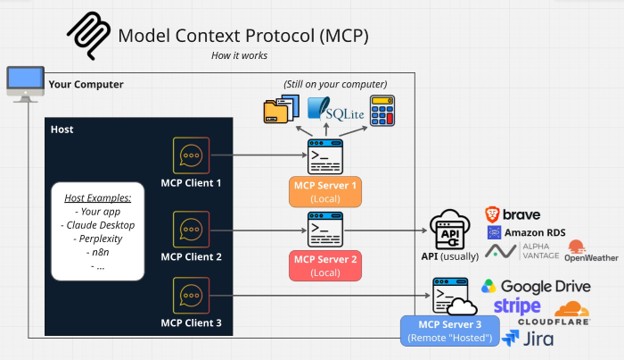
Every MCP setup has three parts, always:
- A Host — where your code runs (your app, Claude Desktop, an n8n flow, a notebook).
- A Client — created inside the host. One client talks to exactly one server.
- A Server — the thing that actually does the work.
Picture the client and server as two ends of a phone call. The client dials; the server picks up.
The only real variable is where the server lives and what it touches. Three flavors:
- Local: runs on your machine and acts on your machine — files, SQLite, a calculator.
- Local, reaching out: runs locally but calls the outside world via API — search, weather, stock data, a database.
- Remote (hosted): a provider runs it for you — Google Drive, Stripe, Cloudflare, Jira. You just build the client and connect.
That’s the whole thing. Host, client, server — every single time.
Most people copy-paste an MCP config and hope. Hold this model, and you can actually build and debug your own.
Build it, don’t just wire it,
Kirill
P.S. The “aha” in the workshop was always the same moment: realizing you launch the server, you don’t call one. That single shift turns MCP from magic into something you can engineer. Want to burst some more myths?