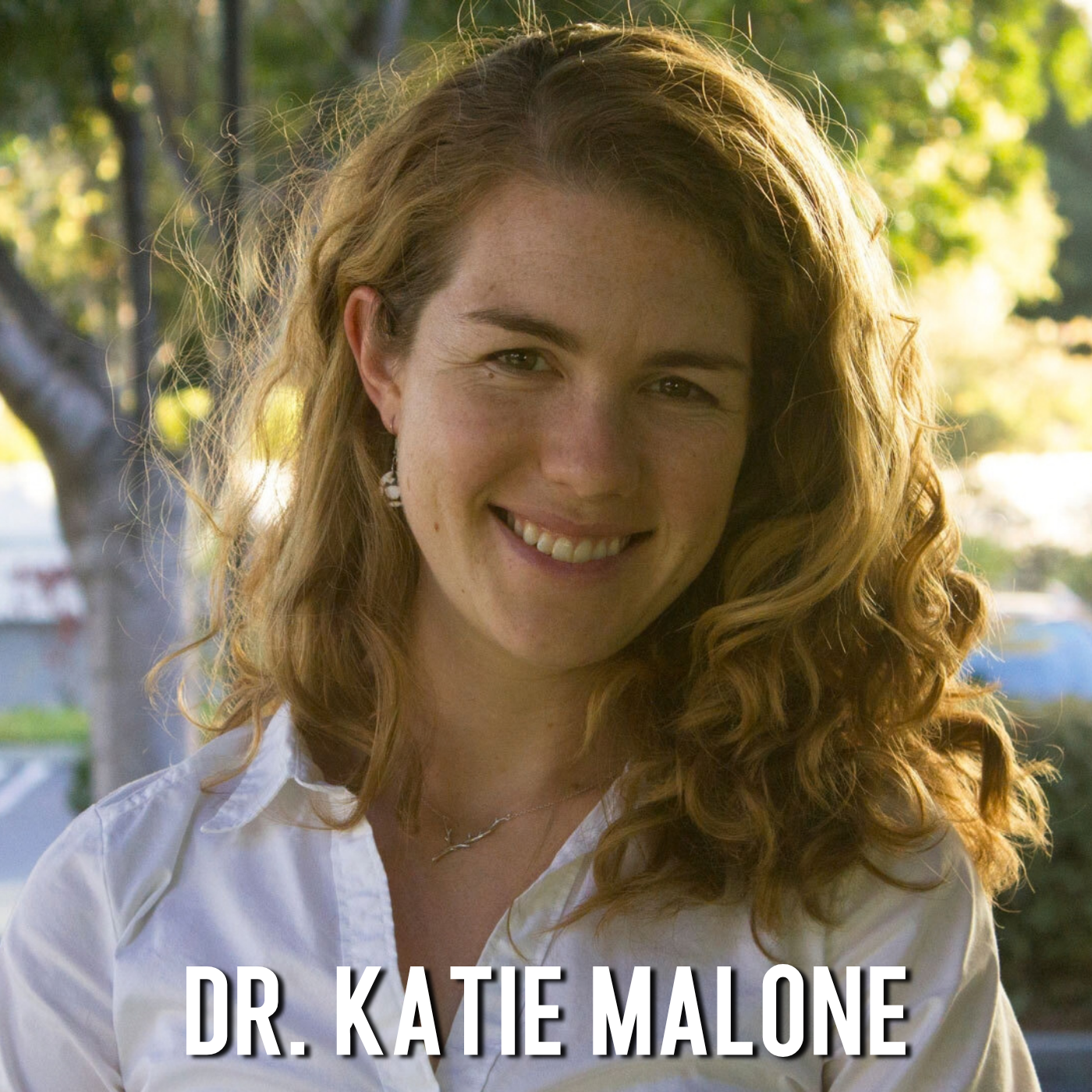
Jon Krohn: 00:00:00 Her podcast went silent for five and a half years. Then AI made it possible to bring it back and to manage it like a team. Welcome to another episode of the Super Data Science Podcast. I’m your host, Jon Krohn. Today’s guest is Dr. Katie Malone, host of Linear Digressions, one of the world’s most popular data science podcasts. Katie earned a Stanford PhD in experimental particle physics working on CERN data, and then she taught machine learning at Udacity and the University of Chicago. Most recently, she’s been leading the development of agentic AI platforms for large organizations and her podcast. In this episode, Katie explains why managing people and managing AI agents are the same skill in different clothing, why AI could hollow out the expertise we need to catch its mistakes and a fascinating range of data paradoxes from Simpson’s to Benford’s. Enjoy this lovably nerdy episode.
00:00:53 This episode of Super Data Science is made possible by Dell Anthropic and the Open Data Science Conference. Katie, welcome to the Super Data Science podcast. How’s it going today?
Katie Malone : 00:01:04 It’s super. It is my pleasure, Jon. Delighted to be here.
Jon Krohn: 00:01:08 So great to have you on the show. Thank you for calling in from Chicago and let’s get right into the meat of things here. So you have been running a super popular data science podcast called Linear Digressions for over 10 years, so longer than we’ve been doing Super Data Science. Tell us about the show and why you created it.
Katie Malone : 00:01:30 Well, thank you. A little bit of an interesting and non-linear story, ironically, given the name. So yes, Linear Digression started in 2015. At the time I was in grad school, I had taken a summer off. I was over at Udacity, if anyone is familiar with sort of the mid 2010s online MOOC environment. They were making a lot of online courses. I led one on machine learning with their CEO at the time, Sebastian Thrun. We got to ride in a self-driving car. That was the main reason I took the job, to be honest with you. I did get to ride in it. But anyway, we got to the end of creating this course and there was a bunch of interesting stuff that I had drafted in terms of course content, but we didn’t find a place to put it. At the same time, I was getting really into podcasts.
00:02:22 That was when Serial came out. Everybody was kind of figuring out that this was a medium that had a lot of potential for it. And at the time – Male Kimp. Yes. Male Kimp.
00:02:38 The little jingle for that will live free in my brain for the rest of my life. But at the time, Super Data Science Podcast did not exist. And so a friend and I looked around and said, “Well, shoot, I guess we could just make a podcast.” And so that was how it started. We were in some of the recording studios of Udacity After Hours and launched in 2015. The podcast moved with us. I came to Chicago. My host Phoebe stayed in the Bay Area and we kept doing it together for the next five, six years. So if you’re not familiar what it evolved to be, I don’t think we went in with a particular vision in mind, but I started to think of it as a way for folks who were intelligent, interested, non-experts to learn more about this stuff. I think we tried to keep a high level of scientific rigor so that if you were an expert, you didn’t listen to it and immediately turn it off because we were hand waving past important concepts, but really trying to keep it also an accessible level so that if you were trying to learn about this field, maybe you were one of our students from the course, it was kind of an original conception of the listener or you were someone who was working with data scientists, you wanted to speak their language, something like that.
00:04:01 And data science, of course, at the time was really on a big uptick. And I think there were a lot of people who were wanting to be more conversant, fluent in data science and analytics and that this might be a way that they could learn about it in kind of bite size pieces. And so we did that for five, six years. I got a bit burned out during the pandemic, frankly, and put it down for a while. And then maybe six, eight months ago, two things came together for me and I relaunched and it’s been really fun ever since. So the two things were number one, the production burden has gone down significantly. And that was one of the things that was just really challenging for me to sustain. I’m kind of a one woman show over here. I do all my own post-production research.
00:04:48 So having ways to streamline that with AI was a meaningful quality of life improvement for me. And the other piece is there’s just so much interesting stuff out there to cover. This is a topic, AI in particular, of course, that’s moving so quickly and where there’s so much to cover. So I think there’s a lot of service to be done in having an accessible explainer for what’s going on these days. And just selfishly, I get a lot of joy and satisfaction out of having a couple hours each week where I have to sit down and go deep on something and learn about it. And goodness knows there was a lot of that for me to catch up on. So that is where we are right now and I’m having a blast.
Jon Krohn: 00:05:32 It’s a great program. It is one of the most popular programs in our field. I was looking into this last week because you and I, the way that we met is we were together on the Harvard Data Science Review podcast. And I’ll try to remember, not I’ll try to remember, I’m taking note right now to make sure that I have that in the show notes for listeners if they want to listen to it. And it was kind of a meta podcast episode because Xiao Limang, a professor at Harvard University who runs the Harvard Data Science Review and who is host of that episode, he wanted to do an episode on how AI is transforming how podcasts are created, how they’re consumed. And he brought in you and me to be the guests on the show. And right on air, I looked up in listennotes.com, which is a platform that lets you see how popular shows are.
00:06:20 We are exactly the same. Neck and neck. Assuming we’re the same as last week, we both have a listen score of 53. Both of our shows are in the top half percent of shows. And I think we’re going after a similar kind of listener. I think we’re both, everything that you said about the kind of audience that you’re trying to speak to, people who, if they are experts, we go a bit into technical stuff for them. If they’re not, we try to explain concepts so that people who are coming from other areas can get more into, well, these days mostly AI engineering, I suppose.
00:06:56 But yeah, so very similar in those senses. And I think a big part of why Linear Digressions is such a great show is because you are one, extremely intelligent and two, unbelievably good at explaining concepts. And so to wit, I can actually give, well, I don’t know if it’s not quantitative, but I can give support to my arguments, which is, so you studied engineering physics with a concentration in computer science as your undergrad at Ohio State. Then you went to a little known institution called Stanford for your PhD where you did experimental particle physics. I believe you were working on CERN stuff there, right?
Katie Malone : 00:07:40 I was. I’m impressed by your research process. Keep going. So far so good.
Jon Krohn: 00:07:45 Yes. And I feel like CERN is kind of famously one of those, like the smartest people I know. All of them have worked at CERN. We
Katie Malone : 00:07:53 Should talk about CERN. Yeah, we can do a digression into CERN if you like. It’s crazy.
Jon Krohn: 00:07:57 It’s cool.
Katie Malone : 00:07:57 It’s cool. Yeah.
Jon Krohn: 00:07:58 Nice. We’ll do that in one moment because I think it is super cool. But yeah, so I think that shows how clever you are, but then on top of that, you explain things so well. And I can’t remember the exact detail, but our research pulled up something that you won a teaching award from a university, I believe. Yeah.
Katie Malone : 00:08:17 I got a teaching award from Stanford back in my day and have dabbled in it since. I mentioned it as in part of my intro, getting into podcasting sort of through Udacity and teaching there.
00:08:29 Taught a bit at University of Chicago, kind of the hometown university over here. And I don’t know about you, but one of the reasons that I do podcasting is I get a lot of joy from learning this stuff and just the exposure to the concepts that it gives me, that it brings me is, if nobody listened, I would still do this because it’s fun. And I think teaching is very similar. I think, as I recall, we met a couple of weeks ago, as you said, and you mentioned at the time that you had just started a new teaching gig yourself. So this may be something that resonates with you as well. Be curious what your take on it is, but I think it just leads me to experience and internalize some of these concepts so much more fully to be engaging with them in this pedagogical way.
Jon Krohn: 00:09:24 Yeah. It makes a huge amount of sense. For me actually, and I have mentioned this on air, but I probably haven’t mentioned this on air for years. A big part of why I. So similar to you have the Udacity thing, I’ve been creating Udemy courses for years, which is kind of like the other business that’s doing the same thing and almost has the same name. It’s so confusing.
Katie Malone : 00:09:43 It’s
Jon Krohn: 00:09:43 Uncanny.
Katie Malone : 00:09:44 Yeah.
Jon Krohn: 00:09:46 And yeah, teaching and I think we were. Let’s look here. Yeah. I mean, it looks like you’re probably two or so years younger than me, but we were doing PhDs at the same time. We’re doing undergrad at the same time. So really there’s a lot of commonalities for sure in our background. And one of the reasons, I don’t know if this is going to be common with you as well, so I’d be interested to hear what you have to say. But for me, a big part of why I teach, a big part of why I have a podcast, a big part of why I write books is because it forces me to learn something in detail, something that I think is important for me to know as a practitioner in this space anyway. But I have a big disadvantage compared to a lot of other people that work in our field, not all of them, but many of them, which is that I hate being alone and I am not introverted at all.
00:10:42 So I want to learn these things, but I can’t just sit with a book. I always just want to be chatting with people, having fun. And so by committing to being like, okay, this video course is going to be made by this date, this book chapter’s going to be done, these podcast episodes have to be done by this time.
00:11:06 I get kind of this delayed gratification thing where I’m like, okay, we’re alone. We don’t like being here doing this, but think of all the people that are going to enjoy this later and imagine them. So that’s a big part of why I do it.
Katie Malone : 00:11:17 Yeah. One thing I really like about Super Data Science podcast, and this is something I’m dabbling in a little bit more, I do not have as strong of a background, but you have a lot of interviews. You’ve talked to a lot of very interesting folks in the course of doing this. And I mean, what a heck of a cold open. Hey, here’s this person, if they’re doing interesting stuff, I’d like to talk to them for an hour. And what a way to open the conversation is like, hey, do you want to come talk to a whole bunch of people about something that you care about, you’re probably a world expert in, and oh, by the way, I get to be there. Let’s do something. So yeah, you’ve got a good setup here, I think then for an extrovert.
Jon Krohn: 00:12:00 Yeah, being able to chat with people is definitely. Yeah, being able to interview these people, it’s a great honor and it’s pretty insane because it’s like, how else could I get to talk to Andrew Ng or Peter Abiel or Ethan Molick or Chip Hu Yan for an hour? Why would they give me the time of the day? Yeah, totally.
00:12:21 Yeah, yeah, yeah. That is definitely part of the format. I inherited that format before we even got going, but it does fit nicely with what I’m doing. Nice. Anyway, so an interesting part of your podcast journey is that you started in 2015, so 11 years ago, and you ran it for five and a half years, almost 300 episodes. And then the pandemic summer, July 2020, you stopped and you stopped for five and a half years. You did it for five and a half, stopped for five and a half. The reason you gave publicly at the time, it was that there’s no particular reason, you just couldn’t do it forever.
00:13:06 We have some quotes from you at that time that if you felt that the field was moving away from you, the show had started when people didn’t even know what the realm of the possible was in data science. And by 2020, data science had become as much about management, responsibility and scales about the algorithms, and you said the content kind of stopped pulling at you. Then nearly six years later, you named two causes you hadn’t said before, a pandemic burnout, a grind of production, and you kind of alluded to that now here today where that grind has been alleviated so much by tools like. You just said it before we started recording. What’s the name of the tool for –
Katie Malone : 00:13:44 Descript.
Jon Krohn: 00:13:45 Descript, exactly. Yeah. I can’t believe I didn’t have that right in my brain. But yeah, an amazing tool for allowing people to edit episodes very quickly. Yeah, I don’t know. I find that journey interesting and I wonder how many people do that, but we’re so delighted to have you back on air. Well,
Katie Malone : 00:14:05 Thank you. I’m delighted to be here. And I think this is interesting for me because I haven’t gone in and excavated what I was saying or thinking in 2020. That resonates, that tracks. That sounds like something I would’ve said. And something that I’ve been thinking about a lot lately, and I’m really interested to hear the seeds of it and what I’m saying. So something I’ve been thinking about a lot lately, I mentioned in 2020 that data science was becoming, for me anyway, partly because of just where I was professionally, a lot more about management than necessarily hands on keyboard. And so struggling a little bit with coming up with new content that was faithful to what I thought my audience came to us for when my day-to-day job was managing people. I’m not writing algorithms anymore, I’m going to meetings. And in the time since then, I’ve stayed in data science management broadly.
00:15:01 But I think that with the advent of AI, there’s a very interesting synthesis maybe between person management as a soft skill that you might learn because you have to do it for your job and the technical management skills that you need to be an effective user of especially agentic AI. So the idea that my job now is context switching between different work streams that are each being carried out independently. It’s about defining the task to be done and the acceptance criteria for when it’s going to be complete, that there’s a fuzziness or there’s a lot of different ways that what I say can be misinterpreted or done incompletely or not in the way that I intended. And so I have to be checking for that and kind of a trust but verify type model. Those are all management concepts that transfer very, very elegantly to being an effective user of contemporary AI tools.
00:16:04 This is just an idea that I’ve been developing a lot because I think a lot of people are maybe non-technical, but they have been managing people or projects or whatever for a while. That set of skills might be one that they have very developed. They’re potentially being confronted with the possibility of needing to manage this new type of entity, like an AI agent for the first time and maybe feeling a bit out of their depth. I would say to them, “You might actually already know more than you realize.” I think to some of the very technical people, especially software engineers who’ve been effective ICs in the past and are now struggling as being agent managers and they’re saying, “I hate my job now. I don’t like reviewing other people’s content. I can’t get into flow.” 100% true. And I don’t have answers to all of those problems or all of those questions as a manager.
00:16:54 I struggle with flow. I struggle with context switching. I struggle to articulate what I want sometimes. But there’s a lot of other people that have figured out ways to deal with that and maybe there’s some cross pollination in the other direction. So anyway, maybe more than you were thinking when you asked the question, but I’m interested now that we see this, me back in 2020 saying, “Well, I don’t know if AI is really what I do anymore because I kind of do all this management.” I’m like, “Oh, those are the same things just in different clothing.”
Jon Krohn: 00:17:26 That’s a really interesting answer and I’m so glad that you got into the Agentic stuff right away because I was starting to think after I had posed this question, I was like, “Have we been going on about podcasting too much? Is this just my interest? Is the audience going to be as interested in this as I am?” And I don’t know, lots of advice on hosting a podcast is that you should be getting into whatever interests you, but I was still like, “Maybe we should be getting into the technical aspect of this.” And then you did anyway. So perfect. Yes, this new world that we’re in where we’re doing agentic management, it’s only been the past year that this is something that people are doing. You have worked at a business with tens of thousands of people where you built the agentic AI platform, and this includes deployment, enterprise adoption, responsible AI governance, and there’s a lot there to get right.
00:18:20 I don’t know to what extent you can tell us about what it’s like building, being the person responsible for managing a team of humans and agents to build a agentic AI platform.
Katie Malone : 00:18:35 Yeah, that’s an interesting question. I mean, it’s hard and I think one of the things that’s very challenging right now, and I think this resonates maybe with everyone to some extent, is as much as you can build something that’s compelling and maybe a little bit future-proof and sets us up for some long-term growth and value and whatever, when the goalposts are just moving as quickly as they are, it’s really difficult. And big companies, I think, have it extra hard because they’re kind of like aircraft carriers. They’re just hard to turn. Once they’re going in a certain direction, they can go very, very far, but they tend to not. It’s just not as nimble to get 10,000 people going in a particular direction. I think I do kind of wonder, some of this is just reflecting where we are as a society right now. This might look very different in five years as people have had a chance to acclimate a little bit to some of the AI tools.
00:19:34 People are maybe a little more fluent with it. Some of the norms that I think we’re figuring out now might have settled in a little bit. It might be you feel like it’s not okay to send AI slop to your coworkers or something right now, then –
Jon Krohn: 00:19:47 Yeah, I hope it doesn’t. Please stop. If you’re that one guy, just
Katie Malone : 00:19:52 Stop. Well, it’s not one guy though. Yeah, that’s the thing. It’s like my AI slop is talking to your AI slop. I talked to Tom Davenport a few weeks ago for my podcast. He’s great. He’s wonderful. And for anyone who doesn’t know Tom, he’s been writing, especially enterprise data science and analytics for decades. And he has coined the term process slop, and I think it’s an idea whose time is rapidly approaching of. I’m a job applicant and you are the hiring manager on the other side, and it’s just like our AI slop going back and forth. I have AI generate my resume, you have your AI that reads it, that automatically sends me some kind of reply, whatever. Anyway, so I think that those are challenges for us in general, and in particular in large organizations where you might not have direct personal relationships with the folks that you work with, you’re kind of relying on the machinery of the organization and some of the processes to get things to where they need to go.
00:20:56 Then injecting AI into that all of a sudden is not necessarily fitting in exactly with how these things are working. And so there’s also, I think, a really important part of what you might call change management or something, just how do you get people. How do you turn that aircraft carrier? And I don’t know. I don’t know how much I have to say here that’s deeply insightful or specific and insightful besides it’s just really hard work. And I think it’s interesting to see in some ways as there’s new companies that are popping up, they’re obviously approaching how to build businesses in sometimes very fundamentally different ways. Established companies are retrofitting their operations and their technologies to varying degrees of success or maturity at this point. So it’s an interesting, I guess, period of high flux for us all to be in.
Jon Krohn: 00:21:55 Tom Davenport is great. We had him on the show in episode 647. He writes about a book a year.
Katie Malone : 00:22:00 Did you just have 647 in your head or did you pull
Jon Krohn: 00:22:03 That up? No.
Katie Malone : 00:22:03 Okay.
Jon Krohn: 00:22:04 I was going to say that’s
Katie Malone : 00:22:05 Impressive. Okay.
Jon Krohn: 00:22:06 I did a command F of the word Davenport and it brought me to the right row. All right.
00:22:12 I feel better now. There are a few that I have memorized for various reasons. For example, I was the guest with Kirill Aramenko hosting. So my first experience with the Super Day Designs Podcast, I was a guest in episode 365, and it’s so easy to remember because there’s that many days in a year. Yeah. And then there’s another one. There’s episode 777 is my number one that I recommend to people who don’t come from a technical background because it’s with another big author, Bernard Marr, if you know him, a big author of business books and in recent years, AI books, and he’s got millions of followers online. Really great introductory episode for non-technical people on what generative AI can do. Anyway, I think those are the only two. But Tom, in his episode, there’s a funny line where he quips that somebody else, because he’s a professor as well, and some other professor quipped at him that Tom Davenport has never had a thought that he hasn’t published.
Katie Malone : 00:23:16 He is prolific. He is prolific. I’m proud to say he’s like, “Have you published with Tom Davenport?” It’s like an ERDOSH number or something. I’m proud to say that my Tom Davenport number is one. We have a – Have you? Harvard Data Science Review co-authored article. Yes. That’s model deployment back in the day. Yeah. Arguing that that was a thing that people needed to worry about because it was not as apparent at the time as we thought it should be.
Jon Krohn: 00:23:42 Nice. Well, let’s digress less. And I don’t know if we are digressing linearly or non-linearly, but I will bring us back to a little bit of the track that I felt I had us on, which is that when you are doing things with agentic AI, so you are managing things, I don’t want you to talk about things that are proprietary to anywhere you’ve ever worked, but are there particular tools or platforms that you prefer, say personally, that you think our listeners should be using?
Katie Malone : 00:24:17 Well, I don’t know if anybody’s heard of Claude Code. Highly recommended.
Jon Krohn: 00:24:25 They’re our biggest sponsor this year, so they get our audience here is a ClaudeCode literally every single episode. Nice
Katie Malone : 00:24:32 Job, Anthropic. Well, good taste all around. Yeah. I mean, I think the thing that I would talk about, and it’s the thing that I have my hands on the most, is probably the podcast setup, because I have some agents to borrow a phrase, I think. I first heard this from Dan Shipper over at Every, but he’s got this phrase, Claude Code and a trench coat. So the idea is the core of the agent, the main capabilities to do tool calling and reasoning and planning and things like that is all claw code, but you kit it out with some specialized MCP and instructions, and then all of a sudden it’s a podcast producer instead of just a coding agent. And so anyway, so that’s been one of the tactical pieces for me of that burnout recovery, relaunch the podcast, but without it becoming a huge time sink.
00:25:28 So beyond that, I tend not to be super fancy with my setup. One thing I’ve been having a lot of fun with lately though is adding some telemetry to that agent. I found it to be kind of fun to wire it up to, in my case, Arise that is like an observability platform. Sure. Yeah. Maybe familiar to many. Yeah.
Jon Krohn: 00:25:49 From them on the show, yeah.
Katie Malone : 00:25:51 And they have, among other things, an open source version of their tool. So I had some fun a few weeks ago wiring that up. And it’s interesting because then you get to kind of look under the covers as it were, watch a lot of what the agent is actually doing in servicing the request. And for a nerd like me, that’s actually kind of fun. That’s some of the learning that I get. So it’s both a experimental subject for me and the thing that actually kind of gets my work done on 7:45 on a Sunday night and we need to post the episode. Let’s fire up the agent where there’s some work to do.
Jon Krohn: 00:26:33 I might be teasing hairs here in a way because both of these tools are offered within the same product, but it’s interesting to me that for podcast production, you’re using Claude Code when it seems to me intuitively like Claude Cowork might be the more. It’s interesting that you reach for Claude. I mean, maybe that’s just because of familiarity and you being so technical, but it seems like Claude Cowork is set up to be this. Because what aspects of podcast production involve code? You know what I mean?
Katie Malone : 00:27:08 Yeah, that is a great question. And it’s actually something that I’ve toyed with a little bit. So the boring but true answer is I set up the agent before Cowork existed. And so part of it is just like, you know how I said a second ago, change management is a whole thing and getting people to change what they do, guilty. And I have explored a little bit, poked around at getting what would it look like for Cowork to do the same stuff. I think probably some of this, at least for me, is reflecting that I’m technical by background. You called out some of my early experience. Part of what I want to do with some of these AI tools is feel a little more technical again. I’m not writing code, but I don’t know. It makes me feel kind of cool to see a terminal window going.
00:28:02 And so anyway, I did experiment a bit or consider a bit porting it over to Cowork when that launched. It wasn’t clear that the benefits were so overwhelming that it would be worth the effort. And so again, kind of the boring, but true answer is I was like, “Okay, well, I think I’d rather spend two hours building the telemetry software into it than
Jon Krohn: 00:28:26 Turning the
Katie Malone : 00:28:26 Port over.” But that’s a good catch. I think that it would be a totally reasonable thing for someone else who’s listening to this and wants to do something similar, but it’s just a little bit inverted for them. I bet it would work quite nicely with Cowork.
Jon Krohn: 00:28:39 Yeah, if you’re starting today, but yeah, if it wasn’t around and it’s already working, if it ain’t broke, don’t fix it. It’s interesting how you mentioned how just having a terminal window or whatever makes you open makes you feel cool because I use them wherever I can just to change directories, make a directory, grip something. But actually, as I was thinking about that, I was thinking, “Oh, do I just like doing it because it’s cool or I don’t want to lose that skill that used to be something I needed to be doing all the time?” But actually, as you were speaking, another thing came into my head, which is I think that that experience of being in the terminal window, it’s a lot easier to be in a state of flow than when you’re dragging and dropping all over your machine for some reason.
Katie Malone : 00:29:25 Oh, I think that. Oh, I think you’re onto something there. I had never really thought about it before. And I mentioned it before a little bit. I love flow as much as the next gal, and I think a lot of people do. Yeah, there’s just something a little bit special about you. You put on your headphones, you turn on your ambient techno or whatever, you fire up your terminal window. I feel a little bit less like a, whatever, pencil-headed manager for a few hours. Yeah, I do like having Some amount of understanding how the internals are working. And so I think if I were fully in cowork, it’s probably not impossible to have those internal views, but I’m going to be pushing this code to GitHub. I want to have a pull request that I can open up and see what the diff looks like.
00:30:16 I have a little bit more of a technical understanding now of certain concepts because I’ve asked my agent to explain itself a few times when I’m wondering how it’s doing something. So I find that to be a bit of a virtuous cycle for me.
Jon Krohn: 00:30:31 Makes a lot of sense. So I was yesterday scripting and recording an episode about OpenAI’s GPT-6 Astra, which is not yet publicly available and I’m not cool enough or working at a cybersecurity firm enough to have access to it yet at the time of us recording this episode. And one of the things that I’m super excited about, it’s been probably a year or so since I’ve had an OpenAI subscription. I have been all in on Claude for some time now, but I would be really curious to try, or hopefully it won’t be too long before ClaudeCode does this, one of the new functionalities about it that I think would be so awesome and help us stay in the state of flow and just kind of collaborate better with the machine is that apparently GPT-6 Astra, when you’re using it in Codex by OpenAI, their coding environment, if it needs to ask a clarifying question of you, that will happen, the chat box will open back up and you can provide a response, but it will continue to have agents running in the background on tasks that don’t depend on your answer.
00:31:45 And that’s such an obvious thing to be where we’re going with this technology, but I haven’t personally experienced it yet.
Katie Malone : 00:31:52 Yeah, that does sound interesting. I’ll have to poke around at it. I’m a little bit curious about it too. I myself am also pretty heavily on Claude. Again, mostly out of inertia. It sounds like the OpenAI stuff is neck and neck and depending on the week, there’s cool new stuff that’s on both platforms right now.
Jon Krohn: 00:32:13 But
Katie Malone : 00:32:13 Yeah, I think the flow state is a particularly interesting one. Again, I think about this sometimes in the context of being a manager versus being an IC. I really miss the flow state. That’s much harder to get into when you’re. That was my experience anyway, when I started managing people, you’re bouncing from meeting to meeting, you’ve got people pinging you in a bunch of different channels and you can’t really turn it off in the same way and be doing your job effectively. What you’re being paid to do is to keep all of that stuff moving, just run around touching all the plates. And there can be days when you feel like you’re in the matrix or something where you’ve got all the bullets flying around and you’re redirecting them all. And I guess there’s kinds of satisfaction that one can get in that. Also, if you’re an extrovert, that might sound like it would bring you a lot of energy.
00:33:12 But I know there’s a lot of folks that they’re like, “That doesn’t sound like my idea of a good day coding.” And so what do we do in a world and how do we get the really valuable and unique contributions that those folks have and not make them just the little drinking bird from the Simpsons that sits there and hits accept, accept, accept for all of the requests from Claude Code, but that they’re still engaged in a way. I think it’s a real challenge. And so some of these UX, UI experiments around how to allow the system to go and not get blocked on you while also keeping the correct around of oversight, I’m very interested in seeing what form factors we experiment with in that space.
Jon Krohn: 00:34:03 For sure. Great points all around. I’m going to bring us back now a ways. We’re going to digress less. We’re going to un-digress. We’re going to follow that line back to the main thread a little bit more. We were talking about AI slop and then you brought up Tom Davenport and process slop, which wasn’t a term that I heard before, but it makes so much sense. And so one thing that we pulled up in our research on you is that as far back as 2016, you complained on how Twitter was more and more becoming a platform for bots to talk to bots. It’s a problem that you just – I don’t remember
Katie Malone : 00:34:39 That, but
Jon Krohn: 00:34:39 That sounds like me. It was 10 years ago. I don’t know why you would remember. But it’s a problem you described as bot contamination and is bad for Twitter analytics. Now we have AI slop contaminating human accounts. I see it on LinkedIn all the time. Particularly, it seems like if I make a LinkedIn post AIagents or agenticai or something like that, I will get dozens of just. It’s getting hard for me to say, okay, this is definitely AI slop, but I’ll get 20 different random people that I don’t know and that don’t usually comment making the same point in different ways. And I’m like, this is surely. And there used to be a time when I could definitely tell it was AI slop and I would just delete it. But now it’s kind of like, well, what if two of these 20 people really though this?
00:35:28 I don’t want to delete theirs and I can’t tell which ones they are. So what the heck can we do about this? Especially at a time, you and I both creating a podcast and as we talked about on the Harvard Data Science Review Podcast last week, well in the episode that was recorded last week and came out, well today. Yeah, so it came out at the beginning of September or I think it was the last day of August because they were like, oh, it’s the August episode. We have to get it out. So it was Monday, August 31st is when that episode of the HDSR, Harvard Data Science Review Podcast came out. And yeah, in that episode, you and I both talked about different ways that we’re using AI
00:36:12 For us at the podcast. We use it to create summaries for the superdatascience.com/podcast page because it does it perfectly. It’s just so good at it. And I don’t feel like that’s a place where people. This obviously is taking the thoughts and opinions of myself as the host and the guest, our real opinions, and it’s just condensing it down into a paragraph that is perfect, easy to read, technically correct. And so it’s like that seems to me like a perfect use of AI. But yeah, you talked about an example where, so you create a podcast newsletter where the underlying episode, the intellectual framing, the curation of the topic, the subsequent editing, you do all of that for the episode, but then you ask a model probably like Fable 5.1 or something today to take that and turn it into a newsletter for your podcast. And then when you run that through a tool, so there’s a Substack tool to try to identify what content is AI generated or not, and you said that your newsletter shows up as 90% AI generated, but that’s because you just used AI at the final step.
00:37:25 Whereas a lot of the heavy lifting, almost all of the work was done on the front end by you.
Katie Malone : 00:37:30 Yeah, it’s an interesting spot to be. I’m not too precious about it.That 90% doesn’t keep me up at night, but it did open for me this interesting vein of exploration. I’m trying to do a little research on the side to see if I can understand this methodologically a little bit more because I’m just a nerd and that’s my reaction to these things. But I think it’s an interesting. They do have the concept in Pangram, as I understand it, of AI assisted. So they’re not quite so naive, and I’m not saying that they are, that they don’t see any gray area in between. But yeah, how do you interpret that 90%? What does that mean? And I think, yeah, at least for me, I’m perfectly happy to say 90% of the words here were written by AI, that is factually correct. But in terms of the content that it’s running on top of, yeah, I see a big difference between that and if I were to just do something like, “Hey, Claude, write a episode script in the style of linear digressions on a topic of your choice.
00:38:40 I’m going to sit here and read it. We pass it through the newsletter.” That substantively different from the curation and presentation choices that I’m making upstream of that summarization task. So I think it’s an interesting thing that we haven’t quite figured out how to tease out yet either. Something I wonder about too, and I didn’t get a chance to ask Jao Lee about this, but I’m going to try to wrangle him into doing linear digression sometime and get his thoughts on it. But as it happens, my husband is an academic. He’s working right now as a editor on the board of one of the journals in his field. So he’s looking at, I don’t even know, dozens of papers per month, probably more. And not surprisingly, there’s maybe some distribution of those that seem to have the obvious tells of being AI generated, others much less so.
00:39:42 And their journal has some policies around, in general, saying that you shouldn’t be using AI, but I’m not sure exactly how far that goes. I think it’s an interesting challenge for folks like him and for other people in this field that are acting as curators of content, whether it’s academic material or if you’re in the publishing field, maybe traditionally performing this role of selecting from content that’s been human generated in the past, you might be calibrated to think of this material as having been thought through by a person and I’m going to approach it in that way versus something that’s more just wholesale AI generated and they make different kinds of mistakes. I feel like I’m being a little bit muddled in my thoughts here and maybe that’s because it’s just a muddly topic inherently of when you have a human and an AI and they’re collaborating with each other, how do we think about the contributions of each of those?
00:40:44 I think the final product is not a tidy sum of the two individual pieces. It’s a messier combination and we don’t have all of the machinery right now, I think, to try to tease apart how that might be different depending on exactly what role each of those contributors plays.
Jon Krohn: 00:41:02 Right. Yeah. Lots of talking from both you and me, lots of questions, not really any answers, but maybe something for listeners to think about. Something that you do have answers on is you have a lot of content on your podcast about these laws or these principles or these kinds of named concepts. And I wanted to dig into basically what I’m planning to do for the rest of this episode is to just talk about a bunch of these because I think people will love them. So the first one that I want to talk about is what’s called Bainbridge’s Ironies of Automation.
00:41:39 Good choice. In an episode of your podcast called The Impact of Generative AI on Critical Thinking, you discussed Bainbridge’s ironies of automation, which is when automation gradually erodes the human expertise needed to catch its own edge case failures, especially when humans are supposed to be there to copilot automated decision making, but end up just rubber stamping everything. That’s Simpson’s bird hitting the approved button that you were describing. I think the big problem here is that that could theoretically mean in time, and I feel like there’s clever enough people at Anthropic and OpenAI that are going to, I don’t know, figure something out, but maybe it’s the biggest risk within an organization where you have this agentic system, you have these processes that are self-correcting, that are recursive in some way, and you just end up over time, the process slop, the AI slop, it ends up corroding the whole process.
Katie Malone : 00:42:36 Yeah, it’s a really interesting challenge, the idea of as the automation gets better and better, the human naturally has a tendency to trust it more. They become less experienced in dealing with these cases themselves. They lose some of that expertise. And then in particular, I think there’s an interesting failure mode that introduces itself out at the tail ends where there’s the most complex cases. Let’s imagine the case of a physician maybe, where if you have AI that’s handling maybe some of the most straightforward cases, which it’s probably very qualified to do for simple stuff, then that means that you as a physician are not handling those cases. The only stuff that gets escalated to you is the trickiest stuff, the corner cases, the things that are not easy for an AI to handle, but you’re out of practice at that point, you’re kind of rusty.
00:43:35 You haven’t been doing kind of the reps day in, day out of the simpler stuff to be sharp and catch the stuff that’s out of distribution a little bit. And so I think that is a real challenge and it’s something that I think about sometimes in my work. I’m curious if this is the same for you, where even when I know from experience or I strongly suspect that the AI is going to do a pretty good job, I will sometimes kind of force myself to go in and to change something for the better. It’s not just like go in and make a change for the sake of making a change, but think about where I want to make a change. I think the newsletter is actually a good example of this.
00:44:18 I don’t think I’ve ever put out a newsletter that didn’t have some edit from me. And sometimes these are minor because it does a good job out of the bad. At this point, I have a prompt that’s pretty good and it gets my voice for most cases, but I always read it and I’m always looking for something to change because I think that act of engaging cognitively with the material keeps me sharp in a way that I would not feel the same way if I were just kind of piping it straight in. But I think it’s a hard stance to take. And to some extent, this was something that Tom and I actually were talking about a lot. If you’re in a business setting, some of the advantages, the efficiency gains that you get from AI, they start to disappear if there always has to be a human in the loop overseeing and approving and managing.
00:45:13 So it’s a little bit of a double bind, I think. I don’t know how optimistic I am that we’re going to come out on top on this one, to be honest with you, but here we are. But it’s got a fairly catchy name, which is nice. Bainbridge is a law of automation.
Jon Krohn: 00:45:32 Yeah, it’s cool. Let’s move on to other ones. We can just kind of try to rifle through them here. One that we hear about a lot, but I always need to jog my memory on is Simpson’s paradox.
Katie Malone : 00:45:46 Oh,
Jon Krohn: 00:45:46 This is the one – We talked about the Simpsons.
Katie Malone : 00:45:49 This is the one about how the overall trend can be running in a different direction than the group wise trend. This is a
Jon Krohn: 00:45:59 Deep cut for me. Yeah, exactly. So it would be like, if you look at the whole –
Katie Malone : 00:46:04 I feel like I’m getting a pop quiz right now. Benford’s lock, go. Goodhart’s lock. Go. It is. Shoot, which one is this again? It’s so
Jon Krohn: 00:46:11 Unfair. I get to do whatever I want and I can make them successively more challenging as well. Oh boy. Oh, this is not going to end well for me. It’s just a fun. No, I literally had to look it up just now to remind myself, but it is exactly what you were saying. I was like, I think there was a few neurons firing with this image of where if you look at something across the whole population, let’s say you have data on humans, and so there’s men and women in there. And when you look at it over, if you fit a trend line, you fit a line to all of your data points, it looks like there’s an increasing trend. But then if you break it down so that you’re looking at both genders separately and now you fit two lines to the data, you end up with both lines decreasing instead of increasing when you look across both groups.
00:47:04 And it could be caused by something like men on average are taller or heavier or something. And so it’s like, yeah, you get this weird overall effect when you look at both groups together, but when you subset by these important distinctions, these important categories, the important groupings that we have in the data, you end up seeing the trend going the opposite direction. And probably you can talk about it for a bit and I’m going to look up some real world examples.
Katie Malone : 00:47:33 Well, yeah. And what I’m wondering, the one that I was thinking of right off the top of my head, so something I found pretty interesting to try to follow is this debate about what AI is doing to the job market right now. And I think it’s a pretty complex picture where it’s having heterogeneous effects at different junior roles might be impacted very differently from mid-level to senior, for example. And so teasing out exactly what’s happening with the job market overall and where you see changes, what’s attributable to AI versus any other macroscopic cause might. It’s tricky as far as I’ve gotten. Many people who are much more well versed in this are working very hard on trying to answer that question. But I wonder, that could be an example maybe. I wouldn’t be surprised. I’m not claiming to have seen this, but just by way of illustration, that you might have some sort of result that says overall salaries, let’s say, might be going up for the population, but within.
00:48:42 Or let’s say they’re going down, that might make a little bit more sense just intuitively. Let’s say they’re going down for the population, but they’re going up for the highest earners and they’re going up for the middle and lowest earners. So I think that would be Simpson’s paradox. So how is that happening? Well, it might be the people are migrating between those groups. And so even if the tippy top of the distribution is doing better, there’s fewer people in that part of the band relative, people are kind of falling down the ladder a little bit or something like that. So anyway, yeah, it’s one of those things, it’s called a paradox for a good reason because you’re like, how can it be going up and down at the same time? And yet there it is. So I’m sure economists are thinking about this as they’re analyzing that data, but those are the kinds of things that.
00:49:28 Yeah, well I think as much as AI is very good at data science at this point, I think you would probably agree for a lot of use cases, but thinking through and understanding some of these little trickeroos is
00:49:42 Still part of what we still have to do. Not to say that an AI couldn’t think about Simpsons Paradox, but.
Jon Krohn: 00:49:47 Yeah, I don’t know. I honestly have no idea. I haven’t tried with Fable five to do this kind of thing, to kind of just give it some raw data and say find the trends and try to trip it up on Simpsons Paradox. I wonder to what extent maybe it would be better looking for all these different kinds of paradoxes, maybe you’d have to prompt for that. I don’t know. I don’t know. But I feel like at some point it’s going to surpass us in a lot of these ways. I don’t know. But I think the key thing is the real world context. I think that there is usually somehow there ends up being key pieces of real world context that haven’t made it into the context that you provide to your agents working on it. And maybe that’s a big problem to solve. It’s like a data engineering problem.
00:50:38 I need to have a recorder on me at all times making sure that everything I say, and then an agent takes all of that stuff and routes it into the context windows of all the relevant different projects, the different clients I have. So
Katie Malone : 00:50:53 Are
Jon Krohn: 00:50:53 You saying
Katie Malone : 00:50:53 You have that set up or
Jon Krohn: 00:50:55 This is so.
Katie Malone : 00:50:56 Okay.
Jon Krohn: 00:50:56 I’m trying to say a big part of my life these days is spending time thinking about how do I get all of the relevant context into the context window for an AI agent to be able to do this task for me. And that is still a place where a human can provide a lot of value. Hopefully I’ll be able to provide value there for a while because I would say that might be the number one single task that I do in a typical week. It’s like I spend hours every day just for different tasks. Some of them are legal things like reviewing documents, doing a first pass. Is this something easy? Is everything easy about this form? Or what changes have this new client’s lawyers, what changes have they made to this 50 page contract? Please just spit it out for me. But then you’re like, okay, but what other context is it going to need?
00:52:00 What are the relevant emails or what are the relevant conversations that I need to type in manually? Anyway, so we’ll see what happens. I have a real example of Simpsons Paradox, and apparently it’s one of the best known ones and it’s really easy to understand. So it was a study of gender bias among graduate school admissions at UC Berkeley. And the admission figures for the fall of 1973 showed that men applying were more likely than women to be admitted, and the difference was so large that it was unlikely to be due to chance. So it was a statistically significant finding. But when they took into account information about the different departments being applied to, so you break it down based on departments, it showed that the different rejection percentages reveal the different difficulty of getting into the department. And it showed that women tended to apply to more competitive departments with lower rates of admission.
00:52:58 So yeah, men were applying to less competitive ones, and so it looked like they were getting. Yeah, it looked like there was this gender bias. That’s
Katie Malone : 00:53:07 A good example.
Jon Krohn: 00:53:08 Yeah. Anyway, so there we go. Let’s quiz you on the next one. You’ve done stuff like AB testing, which I don’t think we really need to get into that much, but you go into that stuff into detail. Network effects, shrinkage, steins, paradox, zips law. I don’t know if there’s any of those that stood out to you as another one you’d like to talk about.
Katie Malone : 00:53:28 Is zipslaw the one about the first digit in the numbers?
Jon Krohn: 00:53:32 We did actually have that come up in our research. That is something called Benford’s Law, and it isn’t one that I looked into more, and it isn’t one that I’d heard of before. Can you describe Benford’s Law to our audience, Katie? Yeah,
Katie Malone : 00:53:43 This is a weird one. And the gist of it, again, this is a deep cut, but if you look at. Imagine you have a bunch of numbers that are taken from measurements of some system. And the thing that’s wild is you can kind of pick a lot of different things that you want to put in here. It can be prices of stocks in the stock market. It can be measurements of distances that people are traveling. It can be vote counts in election returns. And if you look at the first digit of those numbers, they tend to. It is not evenly distributed. So you may naively think you have a bunch of these numbers. Let’s take vote counts, for example. I want the vote counts for every county in Ohio for governor. And you look at the first digit, you would think naively that it’s peanut butter spread across all the digits, zero to nine, and that is not the case empirically.
00:54:42 In fact, there’s a tendency to have many more ones and then it kind of starts to fall off and less common to have digits near the end. Of course, you still get those digits sometimes, but it is very much not something that you would think by naively thinking about it. Anyway, what I like about this is number one, it’s just weird and fun. And number two, it escapes me at the moment, but it’s not a total mystery. People have noticed this for a while and there are some explanations of how that can even be the case. I don’t know, I’d have to go back and listen to my old episode to find out. See if I can refresh my own memory. Yeah. But it’s interesting. Yeah. Weird,
Jon Krohn: 00:55:27 Right? And it’s news to me because I definitely, if you told me that you have some large sample of data, whatever it is, I would assume that the integers in those data would be evenly distributed, like you said, peanut butter, peanut butter spread, uniform distribution across those different buckets. Zero, one two, thre four, five, six, seven, eight. We should have roughly even numbers. It’s going to be a tiny little bit of variation, but they should be roughly the same proportions. And as we have more and more samples, I’d expect them to be increasingly uniform. But Benford’s law is that you get ones more often. And so it’s something that’s used in fraud detection algorithms. Exactly. Because when people simulate fake data, they of course have even numbers of all the integers.
Katie Malone : 00:56:11 Exactly. And I think one of the things that I. You’ve picked up on something interesting that no one else has ever picked up on before. So I’m duly impressed by your research process here. But I do, at a certain point in making this podcast, you probably know this pressure too. You’re like, “All right, I need to come up with something. What are we going to do? I’ve talked about a lot of stuff already, so what’s something else that we could go mine?” And anyway, I think that this turned out to be a rich little vein of content that I think I stumbled upon at one point. I came up with some Wikipedia list or something of interesting little numerical properties or laws that are named after people or whatever, and most of them end up being sort of interesting. So I think I’ve done a few more at this point, but if we kept going, I think I would not maintain my score in this pop quiz here.
00:57:11 So leave it at
Jon Krohn: 00:57:12 That. Yeah, no, we will stop here, especially because we’re running out of time. But I will tell the audience because I looked it up just now. So Benford’s paradox refers to the counterintuitive phenomenon where the number one appears as the leading digit in naturally occurring data sets 30% of the time.
Katie Malone : 00:57:27 Yeah,
Jon Krohn: 00:57:28 It’s crazy. It’s not even
Katie Malone : 00:57:29 Close.
Jon Krohn: 00:57:30 Yeah. Yeah. You’d expect 10% or I would have expected. And the number nine appears least frequently, it’s less than 5% of the time. And oh, our human intuition would assume each. So there’s nine digits, not 10. So you’d expect an 11.1% chance, not 10%. But yeah, in fact, it is quite often, and apparently it’s something to do with, although our standard counting system is linear, natural processes often behave logarithmically.
Katie Malone : 00:57:57 Exactly. Yeah. And the thing that’s fun about that is it also. So you might be like, “Oh, well, what if it’s not a base 10 system? What if I did a base two system or something?” And it’s independent of the base system. So yeah, it’s something in the generation process. So if you were thinking that, that was one of my first reactions was like, “Oh, well, what if we just did base two or something like that still
Jon Krohn: 00:58:21 There?” There’s a pretty good explanation here, which is that to go from the number one to the number two, that requires a 100% increase in whatever you’re counting. Whereas to get from the number nine to 10, that only requires an 11% increase. And so there’s more resistance to getting to two than there is to getting to 10, and so you end up stuck at one more often than nine.
Katie Malone : 00:58:46 There you go. Today we learned. Yeah.
Jon Krohn: 00:58:48 That is weird. Well, I did promise that we would talk about CERN. We didn’t really get into that. So well, particle physics, we’ll have to wait for another day unless – Reason to have it
Katie Malone : 00:58:59 Next
Jon Krohn: 00:59:00 Time. Yeah. Yeah, exactly. But maybe we could have an episode dedicated to it because I don’t think we ever have had a particle physics episode, so I’ll make a note of that.
Katie Malone : 00:59:11 That sounds really fun. And yeah, in the meantime, I bet they’re doing some crazy stuff in physics right now. So yeah, that sounds like a blast.
Jon Krohn: 00:59:21 Yeah. Fable and GBT-6 Astra are doing crazy things in physics right now.
Katie Malone : 00:59:27 I have no doubt.
Jon Krohn: 00:59:29 And so as we wrap up this episode, I ask my guests always the same two questions. One of them is for a book recommendation. Katie, what have you got for us?
Katie Malone : 00:59:40 I’ve got a book that I am reading right now that I’m really enjoying. It’s called Music, the Brain and Ecstasy. I’m only part of the way through it, but I think folks who like this content may be similarly charmed by it as I am right now. We have this experience as humans where We really like music. Some people are obsessed with it and have, of course, incredible skills. I think everybody likes it to some degree. And so it’s going through the auditory and neural processing systems of what we experience when we experience music and why we like it so much. And so it’s got a lot of music theory to it and it’s talking about how acoustics work and how your inner ear works and how your brain works and how signals reach different parts of your brain at slightly different times. And we just really love that for some reason.
01:00:31 I haven’t gotten all the way through it, but Music, the Brain and Ecstasy, the author’s name is Robert Jourdain, J-O-U-R-D-A-I-N. And yeah, I’ve been enjoying it a lot.
Jon Krohn: 01:00:45 And this has nothing to do with the music being even better if you’re on MDMA? I
Katie Malone : 01:00:49 Don’t know. There’s a lot that I haven’t read. I would not be surprised if it’s in there, honestly. This is your brain, this is your brain on drugs, and boy, oh boy, does it light up. I don’t know. Good question. I’ll
Jon Krohn: 01:00:58 Let you know when I finish it. This is your brain on ecstasy. This is ecstasy on ecstasy. Oh,
Katie Malone : 01:01:02 That’s
Jon Krohn: 01:01:02 True. Yeah.
Katie Malone : 01:01:04 I think he meant it.
Jon Krohn: 01:01:05 I know.
Katie Malone : 01:01:07 I didn’t get the pun at the.
Jon Krohn: 01:01:10 Yeah, I was like, oh, I don’t know if she understood. Yeah. Right
Katie Malone : 01:01:14 Over my head.
Jon Krohn: 01:01:16 Yeah. But I guess it wouldn’t be surprising either way, even if he hadn’t used the word ecstasy, but something else. Cool. Well, the final question that I ask all of my guests is how can they follow you after this episode? Obviously, we know about linear digressions. What else?
Katie Malone : 01:01:30 Yeah. Linear digressions is the big one. I’m not really on Twitter these days for my own mental hygiene basically, but Linear Digressions has a few ways that you can join along. So the podcast is the main one, get it wherever, find podcasts are sold. And then the Substack newsletter, which is my fable launder. It’s Opus technically, my Opus laundered transcripts, if that’s your jam. And a little bit of content that’s kind of my own original takes in any given week, unique from what we have in the podcast. So yeah, would love to, if you’ve liked this, that might be something that you get a kick out of, so come on over.
Jon Krohn: 01:02:16 Yeah, I think there’s a chance that if you like the Super Data Science podcast, the podcast that you might like most in the world other than this is linear digressions. In a vector space, I suspect we occupy the same location no matter how many dimensions. You’re on that first
Katie Malone : 01:02:31 Principle component together. That’s right. As an aside, I’ve really enjoyed this. Thank you for this opportunity. This has been really fun. I love what you’re doing there too. I think at some point I’m going to try to get you on my show and fan girl a little bit back in the other direction. So just thank you. I’m in awe of your productivity. I think you are over 1000 episodes at this point and someday maybe I’ll be there, but I have a lot of respect for what you’ve been doing here for the community year in, year out, week in, week out. I know what it takes and it’s just an honor to be here and to chat with you.
Jon Krohn: 01:03:15 Well, thanks Katie. The honor is all mine, I assure you, and I look forward to being on Linear Digressions. It would be a dream come true. Thank you so much for taking the time out of your very busy day, and I look forward to providing our audience with a particle physics episode in the future.
Katie Malone : 01:03:33 Thank you, Jon.
Jon Krohn: 01:03:34 I love that episode today. In it, Katie Malone detailed how she relaunched Linear Digressions after a five and a half year hiatus because AI cut the production burden that had burned her out. She talked about why the skills of a people manager transfer to managing AI agents, Tom Davenport’s concept of process slop, Bainbridge’s ironies of automation where as automation gets better, humans trust it more, lose their practice on the easy cases and end up rusty exactly when the hardest edge cases get escalated to them. And we talked about Simpson’s paradox where a trend across a whole population can reverse when you split the data into groups and Benford’s law where the leading digit of naturally occurring data is a one about 30% of the time and a nine less than 5% of the time. Sounds weird, but true. As always, you can get all the show notes, including the transcript for this episode, the video recording, any materials mentioned on the show, the URLs for Katie’s social media profiles as well as my own at superdatascience.com/1029.
01:04:42 Yes, for episode 1029. Thanks of course, everyone on the Super Data Science podcast team, our podcast manager, Sonja Brajovic, media editor, Mario Pombo, our partnerships team Natalie Ziajski, our researcher, Serg Masís and our founder Kirill Eremenko. Thanks to all of them for producing another super episode for us today, for enabling that super team to create this free podcast for you. We are deeply grateful to our sponsors and if you would ever like to sponsor an episode yourself, you can get the details on how to do that by making your way to Jonkrohn.com/podcast. Otherwise, help us out by sharing the podcast with someone else who would love to hear an episode like today’s. Review the podcast on whatever podcasting app you use. If you write reviews on Apple Podcasts, that’s particularly helpful for us and I’ll read them on air. Subscribe obviously if you’re not already a subscriber, but most importantly, just keep on tuning in.
01:05:41 I’m so grateful to have you listening and I hope I can continue to make episodes you love for years and years to come. Till next time, keep on rocking it out there and I’m looking forward to enjoying another round of the Super Data Science podcast with you very soon.